Madeira Mondays: These Shallow Graves by Jennifer Donnelly (Book Review)

”I merely wish to smoke. Sparky can forgive that. You, on the other hand, wish to know things. And no one can forgive a girl for that.” – These Shallow Graves

One of my favorite films growing up was Martin Scorsese’s Gangs of New York. Not typical fare for a teenage girl, sure, but I liked seeing old New York – the glitzy and the grimy. I don’t have any particular desire to live in New York City but it really is a fascinating place, isn’t it? A little Colonial Dutch outpost that slowly became a commercial mecca and now a world center of finance, culture, food, fashion, you name it. And seeing old New York (specifically 1890’s New York) was one of the coolest things about reading These Shallow Graves by Jennifer Donnelly. The book is a Young Adult mystery novel, published in 2015, which follows an upper class society girl who dreams of becoming a reporter and gets mixed up in the city’s underworld when she starts investigating her father’s mysterious death. 

Continue reading

Madeira Mondays: The Devil and the Dark Water by Stuart Turton (Book Review)

What if Sherlock Holmes boarded a 17th century ship? What if, on this ship, there was a series of dark and unexplained happenings: animals slaughtered, strange marks appearing, and, eventually, people murdered. How would Holmes go about solving these crimes and unmasking, as it were, the ‘devil’ lurking in the ‘dark water’?

While Stuart Turton’s novel, The Devil and the Dark Water, of course doesn’t actually feature Sherlock Holmes, it’s obvious that’s what he’s referencing with his central character of Samuel Pipps (who calls himself a ‘problematary’ because, as Turton clearly knows, the whole concept of ‘detective’ wasn’t around in the 17th century, when this book is set). Pipps, and the other characters in the novel, use deductive reasoning to solve the mysterious murders happening on their ship, as it travels from Batavia (present day Jakarta), in the Dutch East Indies, back to Amsterdam. They follow clues, they speak and think very much like Holmes himself. Continue reading

Madeira Mondays: Yellow Fever in Colonial Philadelphia

“The horrors of this memorable affliction were extensive and heart rending.” – Samuel Breck, 18th century merchant, on Philadelphia’s 1793 yellow fever epidemic

In mid August, 1793, the first Philadelphian died from what would become a devastating epidemic of yellow fever. By the end of October, the city had lost nearly 5,000 people – 10% of the entire population.

In the last Madeira Mondays, we looked at 18th century medicine in general – how people thought diseases spread and what they did to try and fight them – and this week we’re going to be diving into how that looked in practice with one specific and fascinating example: Philadelphia’s infamous yellow fever outbreak.

What was the disease? Who were the major players trying to combat and contain it? And how did it change the city afterwards? Continue reading

Madeira Mondays: A (very brief) intro to 18th century medicine

In the last Madeira Mondays post, we looked at a really riveting Young Adult novel: Fever, 1793 by Laurie Halse Anderson. If you didn’t catch that post, this great little book is historical fiction, inspired by the outbreak of Yellow Fever in Philadelphia in…1793 (as it says in the title!). For this week’s post, I had planned on diving into the real history behind yellow fever: what it is, how it spread in the 18th century, and what doctors used to treat it. However, I realized that I couldn’t really talk about that without first doing a brief overview of 18th century medical knowledge in general. Which is a really fascinating and complex subject in itself! Continue reading

Madeira Mondays: Fever, 1793 (Book Review)

Ever since Covid-19 broke out across the world, there’s been a lot of talk about the Spanish Flu pandemic of 1918. I’ve also heard historians, especially medievalists, called upon to talk about the bubonic plague of the 1300’s, and I’ve seen Daniel Defoe’s 1722 book, A Journal of the Plague Year, added to many people’s reading lists! All of this makes sense. People are curious about pandemics of the past and how people coped (spiritually, physically, psychologically) with rampant infectious diseases.

That curiosity is what drove me to read Fever, 1793 by Laurie Halse Anderson. This is a YA (Young Adult) novel published originally twenty years ago, but it definitely has a lot of relevance today. It’s about an epidemic that you may not have heard of: the outbreak of yellow fever in Philadelphia in 1793. Continue reading

‘Nothing of Floods’: A Poem

I felt compelled to share a poem with you today.

I recently received the sad news that my grandmother in Texas – who I was very close with – died of Covid, so I wanted to post a poem that I wrote several years ago about her.

Like many poems, it’s a blend of fiction and fact. In many ways it’s about the stories that we tell ourselves to understand the world and each other. My grandma and I didn’t see the world in exactly the same way. She was very religious, a Southern Baptist, specifically, and this brought her a lot of peace and comfort. I’m not religious at all. As I grew up, there were times when this caused some friction and I was really forced to reckon with how I could love and respect someone so much, who saw the world so differently? Who I disagreed with in so many fundamental ways? Of course, I don’t have any ‘answers’ to those questions. But I suppose poems are more about asking questions than they are about offering answers.

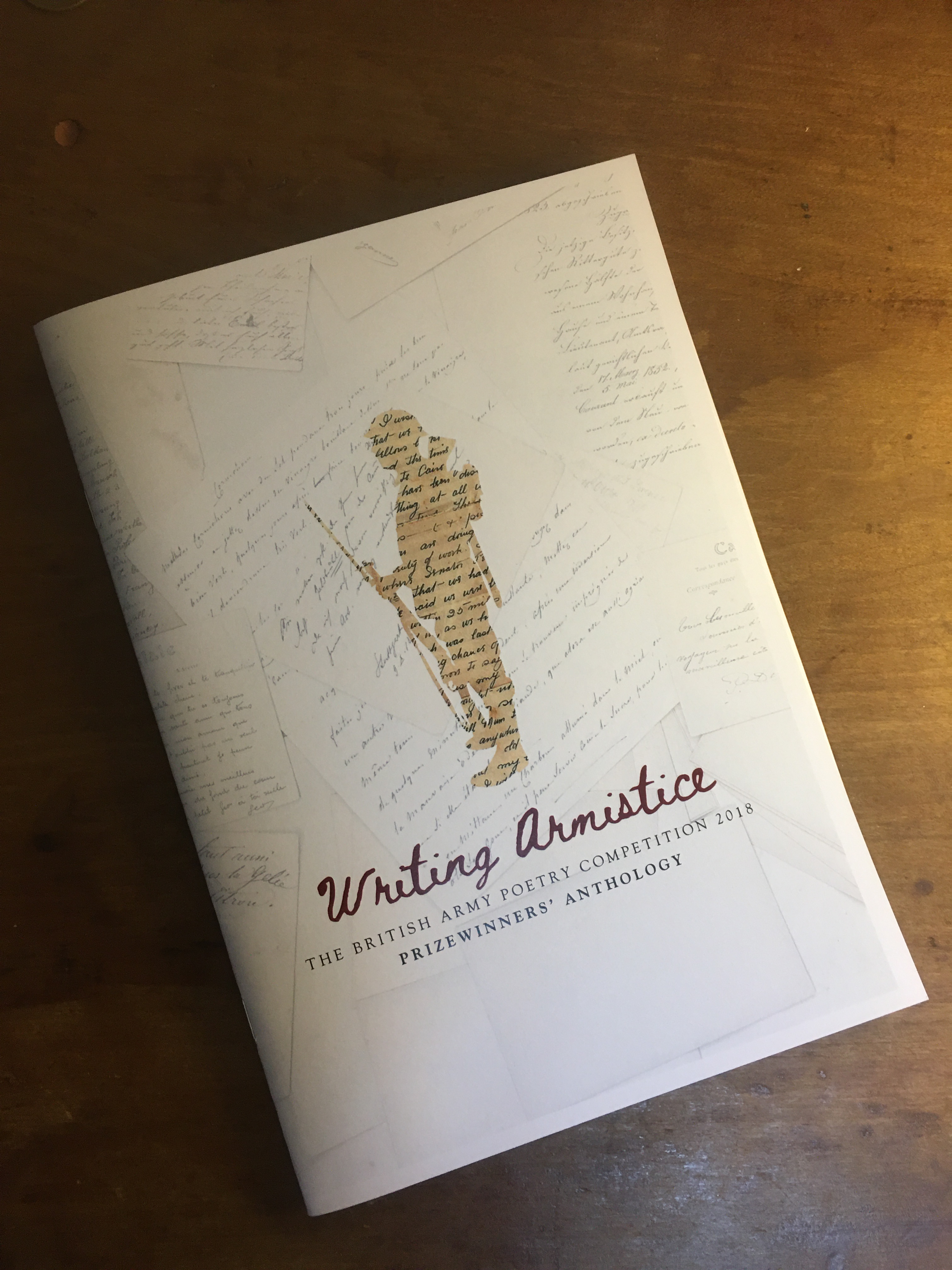
I wrote this poem in early 2018. It was commended in the British Army’s Poetry competition on the theme of ‘Armistice’ (to commemorate the one hundred year anniversary of the armistice which ended WWI) and first published in their prizewinners anthology, Writing Armistice. I really liked responding to this theme. For me, it was interesting that an ‘armistice’ doesn’t mean necessarily the end of a war, but instead it’s a formal agreement to stop fighting and to work towards peace.

I loved my grandmother. And love isn’t always smooth or simple, as you know. Sometimes divides cannot be crossed. But sometimes, they can be. I am thinking of her today, and I’m thinking of all of you, hopeful that you haven’t lost someone during this time. But if you have, I’m so very sorry and you’re not alone. I’m doubly sorry if you’re apart from your family and friends as well, which makes these things extra hard to endure.

I’ll be back next week with more historical and literary explorations for you. (I’m excited about this upcoming ‘Madeira Mondays’ in particular, which is about a great historical novel that explores disease in early America). Until then, thank you so much for reading, it means a lot, and I hope you like the poem.

*

Nothing of Floods

Grandma, when I pinched the skin
on the back of your hand
it made mountains, slow to sink
back to land.

We watched movies with kids singing
Jonah and the Whale –
I imagined bone rafters,
swamps of grey stomach sludge,

and Noah’s Ark –
horse eyes through wooden slats,
sea spray in a man’s beard
like dew on grass.

I said, ‘I prefer Tolkien
or Grimm’s’ –
dwarves in damp caverns,
talking trees,
Elf writings on rock.

You screamed, ‘This is not a fairy tale.’

But not as much as you screamed
when I asked why God
was not a woman?

You said
I would go to hell.

I called you naïve,
for believing those things,

as rain clattered down
on your tin trailer roof.

We didn’t speak for a while.

When we talked again
it was about jewelry,
traffic, butter in mash potatoes.
Nothing of floods, sons of God,
vengeful Pharaohs.

Sometimes I dream of a manger –
crisp straw poking holes
in our cotton dresses,
heavy barnyard smell
draped over our shoulders,
slick newborn with fat cheeks
sobbing.

Outside, the moon tugs at water.
I pull up loose skin on the back
of your hand. You kiss my forehead
as stars whir with delight
because they are memories
flung through time,

whether or not
you believe it’s magic.


Madeira Mondays: Great Expectations (Book Review)

‘I never had one hour’s happiness in her society, and yet my mind all-round the four-and-twenty hours was harping on the happiness of having her with me unto death.’ – Charles Dickens, Great Expectations

I was meant to read Great Expectations at university. I know that because I have a distinctive memory of one of my professors, who was also my undergraduate dissertation supervisor, Phillip Mallet, discussing and dissecting the ending of this book in front of our Victorian novel class. I nodded along like I knew what he was talking about (It was not the first time I had sat through a lecture on a book I hadn’t read!). And while Phillip Mallet was an excellent lecturer, I’m glad I remember very little of what he said because this book was so full of twists and turns, it would have been a shame to learn about them all secondhand.

Which is why I will try – for today’s Madeira Mondays – to discuss this book without spoiling it. What I can spoil is that: I thought it was amazing. I enjoyed it even more than A Tale of Two Cities, which I reviewed last summer. What makes it so great, you ask? Well I shall endeavor to tell you (spoiler free!!), so you can decide if it sounds like a book you’d enjoy too!

What’s the book about?

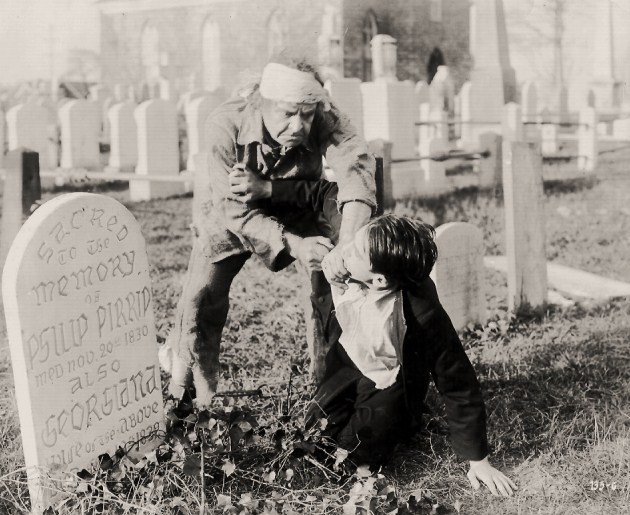
Great Expectations (1860) is a coming-of-age story. It’s probably one of the most famous coming-of-age stories in the English language, I’d say? It tells the story of a young orphan called Phillip, nickname ‘Pip’, who, in the famous first scene, encounters a terrifying escaped convict in a graveyard, demanding Pip’s help. ‘Keep still, you little devil,’ the convict cries, ‘or I’ll cut your throat!’ The convict is described as vividly as you would expect from Dickens, who is a MASTER at character descriptions, and zooming in on little details of people’s clothing or physicality to give you an amazing picture of who they are. The convict, who we later learn is called Magwitch, is described as:

A fearful man, all in course grey (…) A man who had been soaked in water, and smothered in mud, and lamed by stones, and cut by flints, and stung by nettles, and torn by briars; who limped, and shivered, and glared and growled; and whose teeth chattered in his head as he seized me by the chin.

Can’t you see the convict? I can. And, again without giving anything away, this book is populated throughout with many similarly vivid characters – from the terrifying and tragic Miss Havisham, jilted at the altar and who still, many years later, wears her wedding dress and haunts her own dilapidated manor house, to her beautiful, serene, cold-hearted protegee Estella.

Pip meets Magwitch in the graveyard. A publicity still from a 1917 adaptation of the book from Paramount Pictures, accessed via Wikimedia Commons

Pip must navigate complicated and, at times, heart breaking interactions with all these people as he grows up and tries to ‘better’ himself and improve his social class in Victorian England. Along the way, he makes mistakes (so many), which leads me on to why I think this is probably the best Dickens book I’ve read so far. Pip is probably the most believably human character I’ve encountered in a Dickens novel (keep in mind, I’ve only read A Christmas Carol, A Tale of Two Cities and this one). I love Dickens, as you know, but usually he’s one for larger than life characters, who sort of STAND for something (greed, corruption, etc.) rather than having characters who just feel like people. Great Expectations certainly has a lot of those larger than life figures, but because it’s a first-person narrative (this is Pip telling his story), and Pip just feels so human and fallible, I thought it was the most complex and involving of his books I’ve read.

What does Pip do that is so human and realistic? Well, he makes a lot of bad choices. Namely, and this doesn’t give too much away, he immediately falls in love with Estella who is, to put it bluntly, an asshole. We (the readers) know it. Pip knows it too. Dickens knows it. Everyone knows it. She’s so mean to him, for years, and yet…he’s infatuated with her, dreams of marrying her etc. I totally believed this. It’s such a poor choice to pursue her, and yet. People do this kind of thing in real life all the time. They become enamored with people who aren’t nice to them, they idealize their beloved and they let people become symbols, in a sense, making them more than what they are. For example, Pip loves Estella because in many ways she represents the refined, upper class life he so craves. If he can have her, he can have that, etc.

Again, I don’t want to reveal too much, but Pip makes so many selfish and short-sighted decisions, while, overall, being a fairly decent person. He’s never so awful or so cruel that you strongly dislike him, he’s mostly just a bit careless and self-centered (as people often are!). By the end, I totally believed in his humanity and I very much wanted him to be happy. But what is happiness? Is he going to have to learn to redefine what it means to him over the course of the book…who knows?? (hehe)

Also, as a bit of an aside, Dickens gets a lot of flak for his portrayal of women. I can understand that. In the three books of his I’ve read, none of the women reach near the complexity of a character like Pip, or A Tale of Two Cities‘ wonderfully compelling Sydney Carton. His women are interesting – no-one can say that Miss Havisham isn’t interesting!! – but they’re extremes. They’re extremely eccentric, or extremely angelic, or extremely violent, etc. I’m not sure we can entirely blame Dickens for this. Did his society encourage him to consider the internal complexities of the women around him? Probably not. Did he speak openly and candidly with women (his wife, friends, sisters) about their lives? Probably not. I’m just saying that Dickens in many ways was an author who wrote what he knew, and I don’t think that he knew, or could possibly even imagine, what sort of fears, hopes, desires, dreams would be in the heart of a little girl like Estella, versus a little boy like Pip. It’s a limitation of his writing, but not one that ruins it for me, by any means. I loved this book.

‘I entreated her to rise’, an illustration of a scene between Pip and Miss Havisham towards the end of the book, from an 1877 edition of Great Expectations. Image via Wikimedia Commons

One final other ‘flaw’, in my opinion, is that the middle of the book drags a bit, but the first section and the final section were incredibly paced and made up for a bit of a lull in the middle.

I’d recommend Great Expectations if you’re into character-led stories, whereas I’d recommend A Tale of Two Cities if you’re into more action-led stories. That book was a lot about justice, redemption, protests, mercy, whereas this one is a lot about inheritance, class, and how, as we grow up, our values and our priorities change. Even though Cities was set in the 18th century (my time period!), I think I preferred this one. I’m a sucker for a good first-person story and this is probably one of the best I’ve ever read.

‘Madeira Mondays’ is a series of blog posts exploring 18th century history and historical fiction. Follow the blog for a new post every Monday and thanks for reading!
 

Writing Reflections: Thoughts on launching a book during lockdown

It’s officially been six months since my second poetry pamphlet, Anastasia, Look in the Mirror, was released out into the world! And what an unusual six months it has been…

I wanted to take some time today to reflect on the unique challenges (and opportunities!) of launching a book at such a strange time and a couple of things I’ve learned along the way. I hope this will be helpful to fellow writers who are launching their own books or creative projects right now and interesting to those who want a bit of a peek into the process of releasing a poetry book.

I won’t be talking too much here about what the book is about – for more on that, check out this blog post from July! But these are poems about lots of things I’m interested in: history, art, desire, the unexpected places where the personal meets the political. They’re mostly funny and lighthearted. Gutter Magazine’s Calum Rodger generously described it like this in a review:

Carly Brown’s Anastasia, Look in the Mirror (…) intersperses sharp and funny patriarchy take-downs with ekphrastic poems on the Scottish Colourists. It’s a brilliantly-crafted assemblage full of wit, warmth and panache, ‘a suitcase so full / it would not / shut’.

Thanks Gutter!

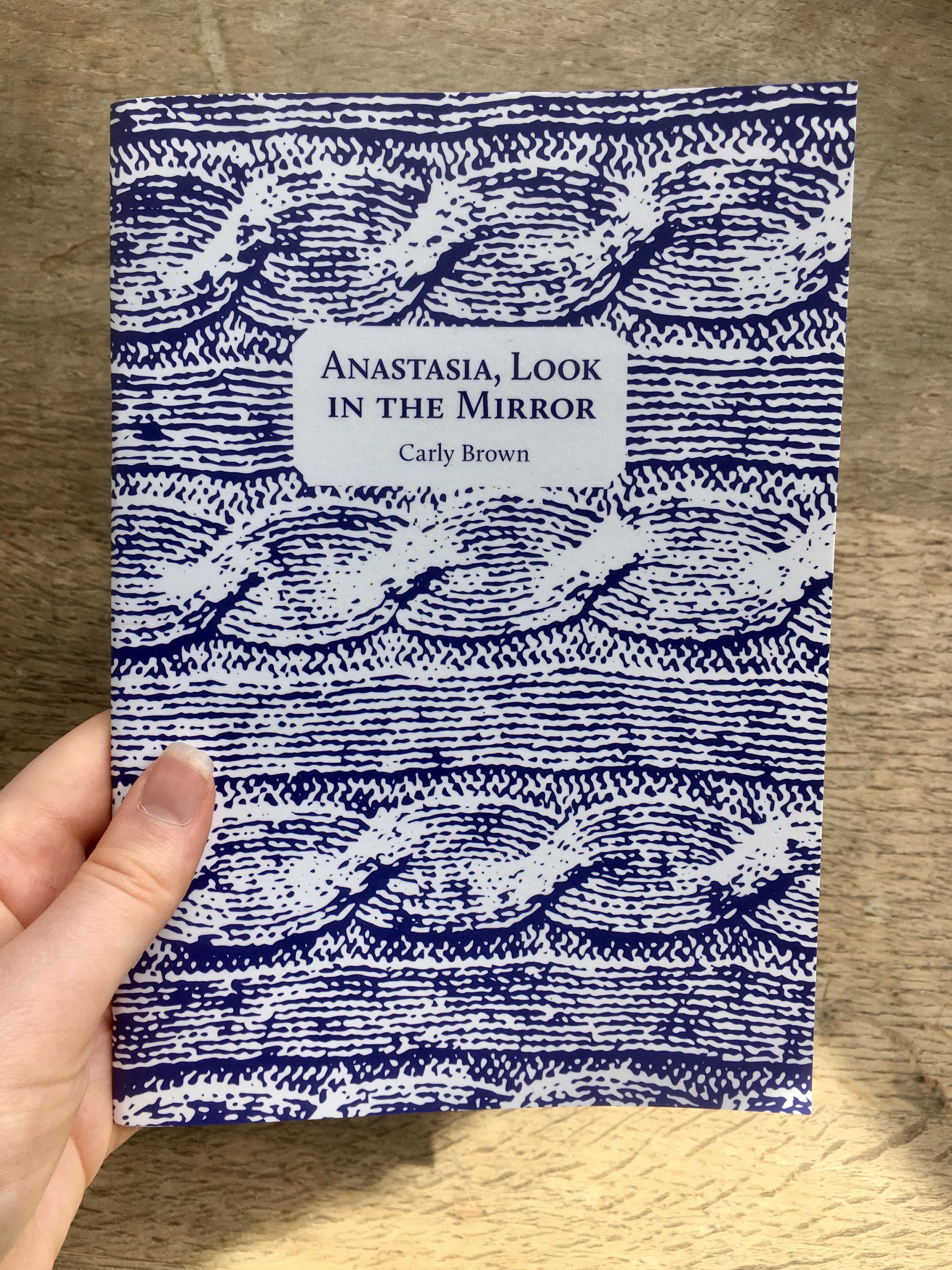
Ta da! Here she is! The cover is very fun to stare at, and it was designed by the very talented James T. Harding.

The book came out with Stewed Rhubarb in July 2020. Stewed Rhubarb are a Scotland based independent press which specializes in spoken word poetry. So a lot of their poets (myself included) have a strong performance background and either write for the stage or have performed extensively. It was published as part of a series of four pamphlets, all from emerging poets based in Scotland (like myself!), called The Fellowship of the Stewed Rhubarb. The whole project was the result of a successful crowd funding campaign in late 2019 and the books were all set to launch throughout 2020 and into early 2021. Mine was the second book in the series, the summer book.

Prior to the pandemic, Stewed Rhubarb had planned launches for my book in both Edinburgh and Glasgow in July 2020. AND there would have been launches for the other three books too AND there was meant to be a big party in December 2020 for all of the generous Fellowship subscribers who supported the whole project, as well as our friends and family. However, as you know, 2020…happened. All of those in-person celebrations had to be cancelled.

I was at a bit of a loss, quite honestly, about how I was going to be able to share this book with people – especially when a lot of the way that I’ve sold books (and found new readers) in the past has been at live performances. I’m a performance poet, after all!

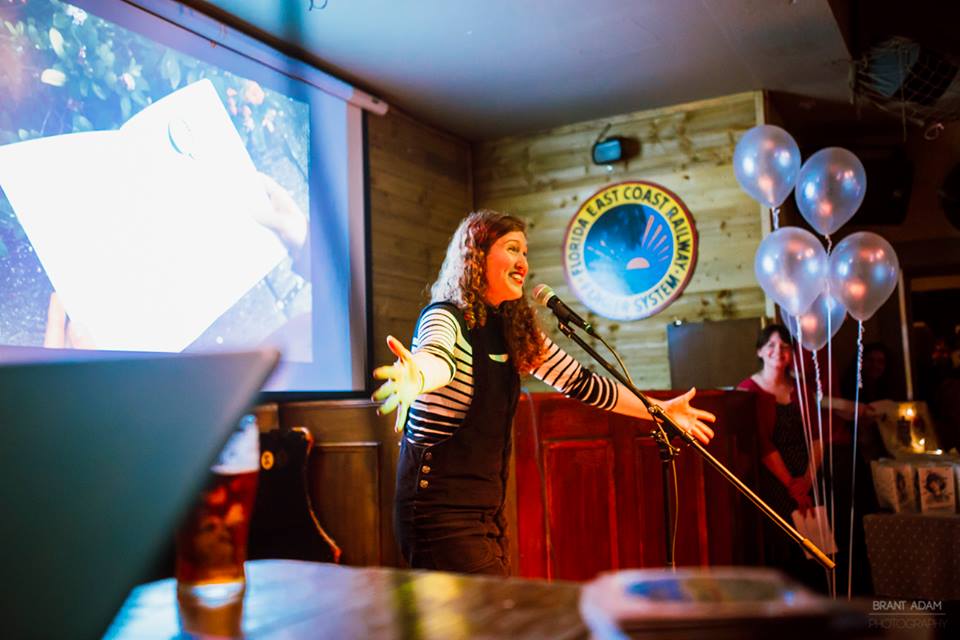
Throw back to a live performance I did back in 2017, at the Quotidian Magazine Issue 3 Launch party.

So how the heck were we going to help people find this book?

First of all, luckily Stewed Rhubarb has an in-house publicist, the lovely Charlie Roy, who took the helm for the social media side of promoting the book (I am not the biggest fan of social media, quite honestly, although I do think it can be a useful tool. I’m not on Facebook, I’ve not updated my Instagram in about five years, and while I do have a Twitter profile, I often feel like that website drains my soul, distracts me from writing, makes me feel anxious and a whole host of other negative things. Basically, I use it sparingly!)

So what I set to work doing was finding online places where I could share poems from the book, and actually connect with and talk with readers live – which is what I love to do most of all! I reached out to organizations, universities, and festivals I’d performed with before, and to organizations that I saw were doing very cool online events. (This is something I’d recommend, if you’re launching your own project right now. Think about what resources/connections you already have and also spend some time researching online events/festivals/places you might want to be part of – there might be more than you think!)

Happily, there were many events popping up throughout the latter half of 2020, and I was able to share poems from the book quite often, perhaps more often than I would have if it had just been at local in-person events.

And, on the plus side, I got to share the book at international events and festivals that I probably would not have attended in-person, just out of logistical challenges, such as the readings that I gave at the American University of Dubai!

I’m grateful for the ingenuity of so many event organizers, who rapidly transitioned their events online. Here are some of the places where I’ve shared poetry from Anastasia in the last several months…

The Anastasia Virtual Book Tour

(Or, events where I’ve READ poems from the book, in the last six months)

  • ‘Meet the author with Carly Brown’, University of St Andrews’ Countdown to St Andrews online program for first years, a half-hour poetry performance and then Q and A with St Andrews university students, organized by the university library (August 28, 2020)
  • Sonnet Youth #13 (September 13, 2020), an online performance with the other three other poets in the Fellowship of the Stewed Rhubarb (You can watch this entire event online here!)
  • London Center for Interdisciplinary Research’s Poetry Conference at the University of Oxford, ‘International Poetry Reading’ (September 20, 2020)
  • The Stay-at-Home Fringe Festival, University of Glasgow’s Creative Writing department Open Mic night (October 9, 2020), invited to share poems from Anastasia alongside current members and alumni of the University of Glasgow
  • Inklight: The University of St Andrews’ Creative Writing Society (October 12, 2020), a half-hour performance and then Q and A with Inklight members
  • ‘A Poetry Evening with Dr Carly Brown’ at the American University of Dubai (November 24, 2020), an hour long poetry reading then discussion with the students

Aside from performances, another good thing that happened after the launch of the book was that a poem from it – ‘En Plein Air’ – was republished in Scotland’s national newspaper, The Scotsman, as their ‘Poem of the Week’ in July. The poem is an ekphrastic poem, responding to a work of visual art, and the publication was accompanied by a very good description of what ekphrastic poetry is.

Excited me with The Scotsman

Two poems from Anastasia have also been re-printed in the American University of Dubai’s Poetry Journal, Indelible, in their issue on the theme of ‘Escapism’ (god knows, we all need a bit of escapism right now!). You can read the whole journal here. AND I’ve recently been approached by another writer about translating one of the poems from Anastasia into Spanish – so I’ll share more about that when I can!

It’s also gotten some very positive (and beautifully written) reviews, such as the one I mentioned earlier from Gutter, as well as this lovely piece in Sphinx Review.

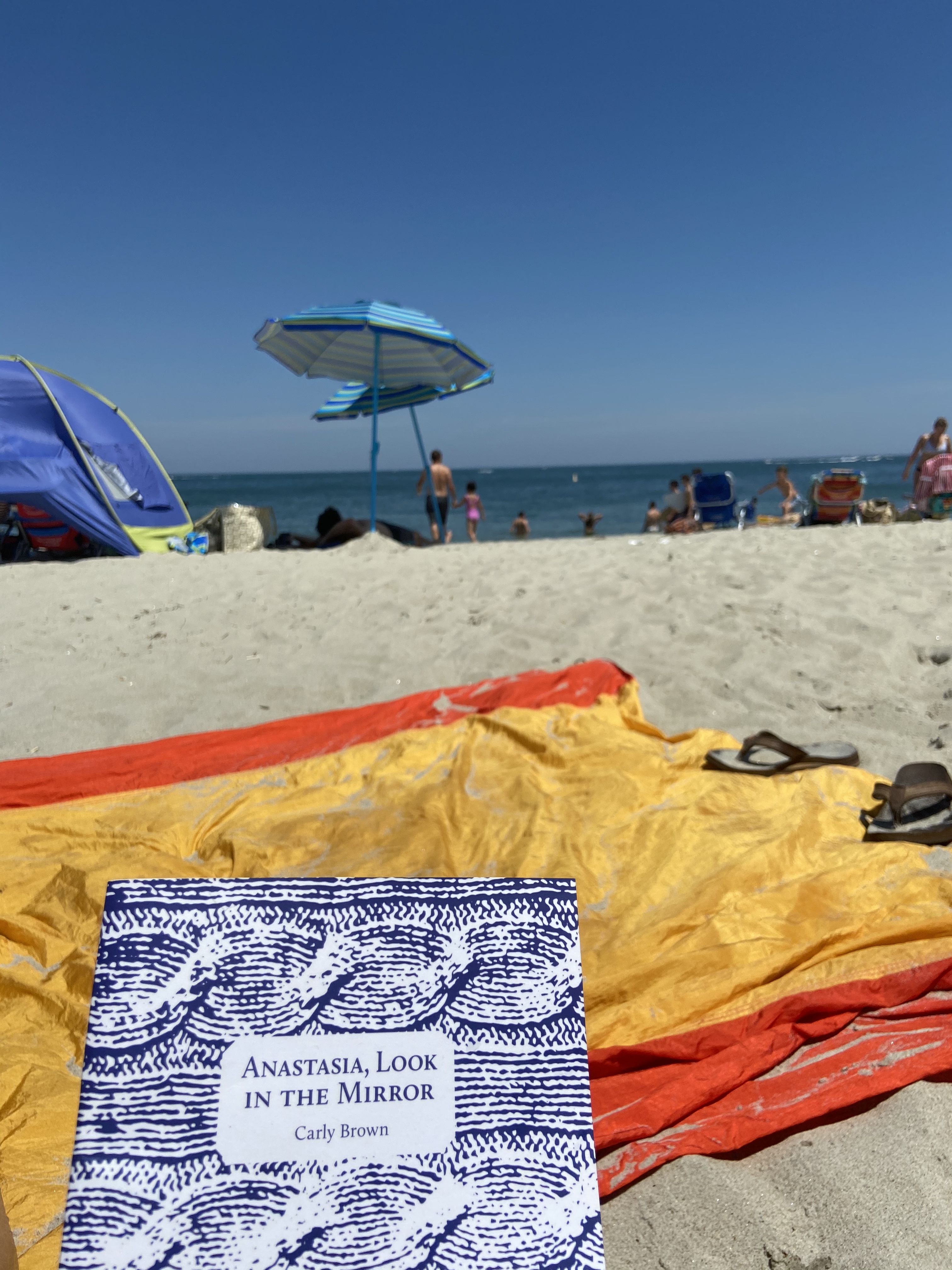
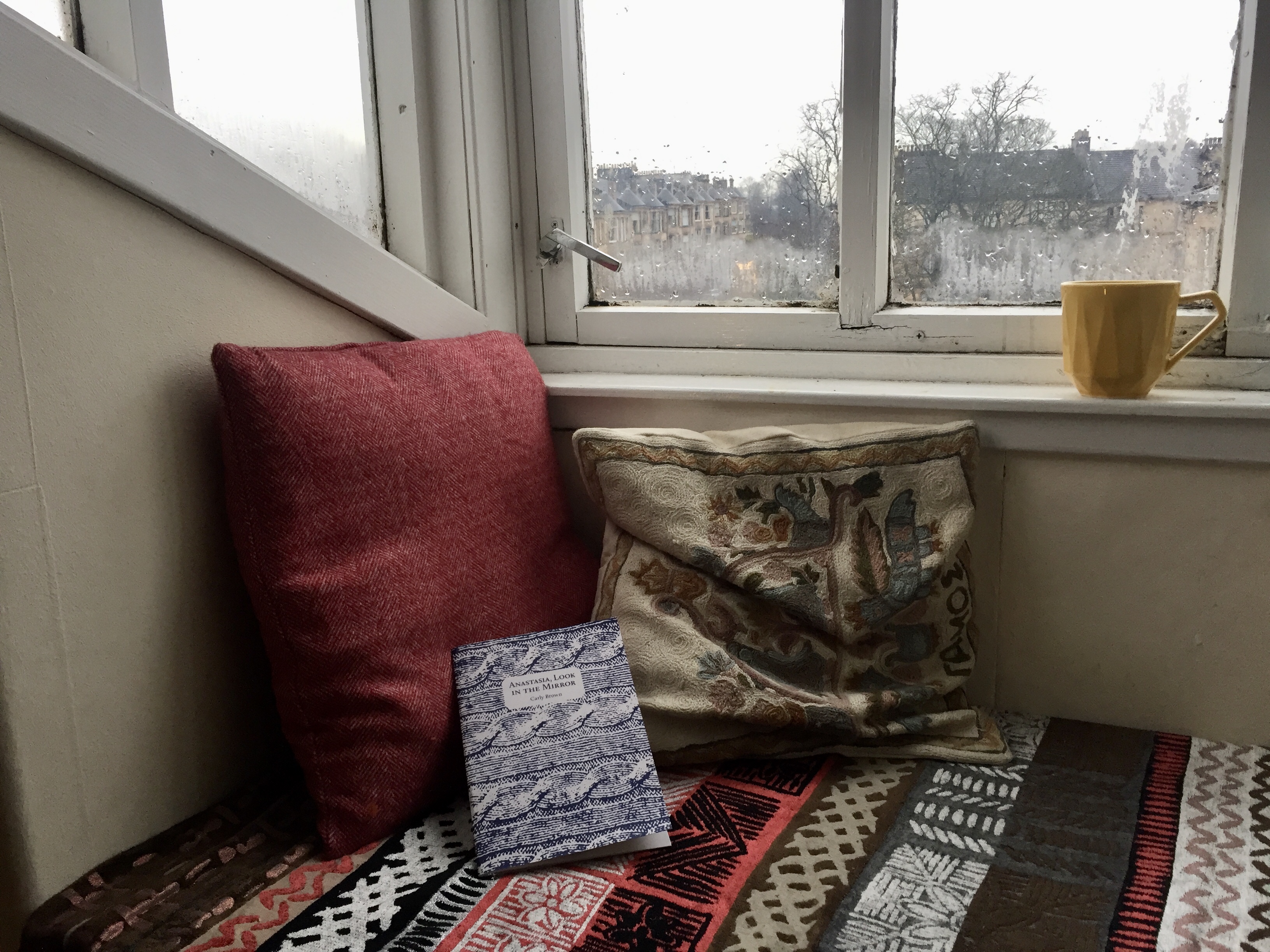
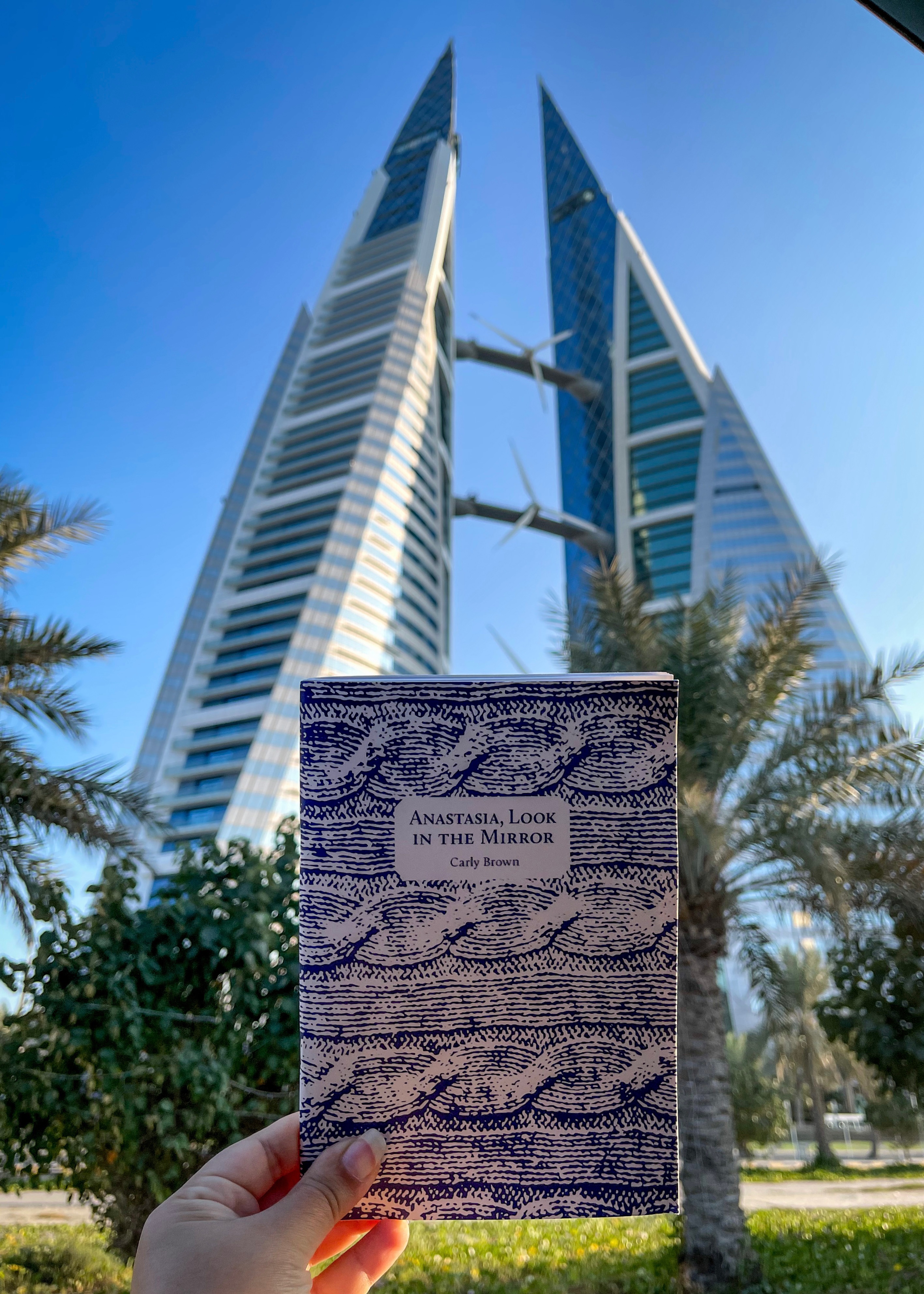
Another delight, aside from these publications, reviews, and meeting people through the online performances, was seeing pictures and hearing stories of people reading the book in locations all over the world. While I’m not able to travel myself right now, Scotland is in serious lockdown, it made me so happy to hear friends from all over reaching out and telling me that they were reading the book. They sent me pictures of the book in their homes, with them at the park or on vacation, and told me stories of how they read it aloud to one another on camping trips. One friend shared that she had read a poem each morning with her morning coffee.

These stories were a joy and made me feel like I was connecting with people at a time when that’s what we all so desperately needed! It also made me happy that the poems could travel – even though I could not.

Anastasia hanging at the beach in Massachusetts, USA with my friend Emma

Anastasia chilling in my friend Miranda’s cozy window seat in rainy Glasgow, Scotland!

Anastasia travels to Bahrain! My friend Laala generously took this photo in front of the Bahrain World Trade Centre (which, fun fact, is apparently the first skyscraper in the world to integrate wind turbines. So cool!)


I don’t have any overarching take-away from this, except to say that I’m grateful to everyone who has bought and read the book, and everyone who has invited me to perform at their events.  While it is not the same performing over Zoom, it has opened up a whole new world of possibilities and I’ve certainly met new people, from all over the world, that I would not have encountered otherwise. And, in such a dark year, that was a beautiful and surprising thing.

I hope that Anastasia has brought some joy, entertainment, and even companionship to those who have read it. While most of our worlds are physically small right now, books can open up our intellectual worlds infinitely and remind us that we’re not alone.

Have you read ‘Anastasia, Look in the Mirror’ and, if so, which poem was your favorite?

Fellow writers and artists, do you have any tips for me on how you’ve been sharing work with audiences during this unusual time? 

If you’d like to grab a copy of Anastasia, Look in the Mirror, the easiest way to do so is to order it online on the publisher’s website here (they ship internationally!!)

Further links:

  • My blog post from July 2020 about launching the book
  • A blog post where I explore the historical research behind one of the poems, which is about the Salem Witch Trials (this one is perfect if you want more of the nitty gritty of writing one of the poems!)
  • Lots more general info about the book and what it’s about here
  • My editor Dr. Katie Ailes wrote a really fascinating post about the processes of editing the pamphlet together, you can find that on her website here
  • Stewed Rhubarb’s website, where you can find lots of excellent poetry pamphlets and full-length collections (if you enjoyed mine, you’ll probably find many others there that are right up your alley!)

Stay tuned for more ‘Writing Reflections’ this year, my friends, as well as more of my ‘Madeira Mondays’ series about 18th century history and historical fiction reviews. Please do subscribe to the blog so that you don’t miss any of that – as well as for news of upcoming performances and publications. Hope you’re having a good day!


Madeira Mondays: Bridgerton (TV Show Review)

Happy 2021, my friends! I wanted to kick off this year’s ‘Madeira Mondays’ series with a discussion on the hit TV drama set in the Georgian era: Bridgerton. But first…

a brief announcement regarding ‘Madeira Mondays’…

I’ve made the decision of switching these ‘Madeira Mondays’ posts from every Monday to every other Monday in 2021. I thought long and hard about this decision, especially considering that some of you have reached out to me and said that reading this series is something that you look forward to each and every week. I loved hearing that. I love writing them. But I’ve got a rather full spring ahead of me, and I just don’t think I can maintain the quality of these posts while still posting each week. And I’d rather cut down on the quantity than cut down on the quality. And I’ll be posting a little more this year about writing reflections and my life as an author, so those posts will take up some time too.

So I hope that’s all okay with you! There may be a time when I can go back to every Monday – we shall see! – but for now it’ll be every other week (or once a fortnight, for those in the UK and/or for those like myself who just enjoy using words like ‘fortnight’). And I’ve got so many posts I’m excited about planned for you – posts on 18th century medicine, more recipes, and hopefully some site visits whenever it’s possible to visit places again! If you find yourself missing the weekly posts, you can always have a look through the back catalogue of ‘Madeira Mondays’, which has now amassed around 70 posts (!), covering everything from historical fiction book reviews, to my historical cooking disasters. I hope you enjoy. Now, back to Bridgerton

What is Bridgerton?

So many people – friends, family – have asked me if I’ve seen this show. I totally get why they ask. I volunteer as a historical tour guide (and occasionally a costumed character) at a restored Georgian House in Edinburgh that depicts exactly the time period when Bridgerton is set. I have been known to enjoy frothy and fun TV shows, and I write about and study this period of history…I get it! However while Bridgerton has its charms – we’ll get to that in a sec – and ticks a lot of my boxes on paper, the first episode wasn’t my cup of tea.

But I’m getting ahead of myself. What is Bridgerton? It’s a TV series (apparently based on a series of 8 books by author Julia Quinn). It was released on Christmas day 2020 on Netflix and produced by TV titan Shonda Rhimes (who created Grey’s Anatomy). It’s basically a soapy drama following the lives of the elite ‘Bridgerton’ siblings as they make their way through Regency London, trying to find socially advantageous marriages (I only watched Episode 1, so perhaps it becomes about more than that, but I think that’s probably a fair synopsis!). I’ve broken my thoughts into different categories so let’s dive into the sumptuous world of the Bridgerton siblings…

Characters and acting

I gotta say that the tone of the acting was great. Maybe the best thing about the show. It’s mostly a set of hilarious and broad performances, which suits this cheeky and fun story just fine! It’s very lively and no-one seems to be taking it very seriously.

The young woman playing one of the daughters, Eloise, reminds me of young Carrie Mulligan. Her name is Claudia Jessie and she brings a very feisty energy and I always enjoyed it when she was on screen.

The hottie playing the Duke of Hastings, actor Regé-Jean Page, was particularly good too. He’s giving me a grumpy Duke Orsino vibe. He actually gave me very ‘Shakespearian actor’ vibes overall, and when I looked him up, I saw he began this career on stage in plays like Merchant of Venice! I knew it! (I did a lot of acting growing up and all through my uni days, including many Shakespeare plays, and I was happy my hunch proved correct!)

The characters are standard fare for this type of drama, nothing special there, but the actors all seem pretty top notch.

The look and sound

The costumes were also good to me. I’m not an expert here, of course, but most people were wearing period appropriate Empire waist dresses, while some of the queen’s ladies and the queen herself were wearing older styled gowns with stomachers etc. The gowns were VERY colorful, particularly for the comical Featherington family, and I got the sense that the costumer was leaning into the fantasy element and trying to almost make them look like costumes. Which I really liked.

Queen Charlotte (center) portrayed by Golda Rosheuvel, wearing a more ‘old fashioned’ gown, which would have been more fashionable in the late 1700’s, rather than the early 1800s, when this is set.

A lot of the score is from the Vitamin String Quartet, which I think says a lot about what they were going for with the show. I, for one, love Vitamin String Quartet: they do innovative musical versions of pop songs. I like their Regina Spektor covers myself! In Bridgerton, we hear instrumental versions of things like ‘Thank you, next’ by Ariana Grande. So instead of actual historical tunes we get pop songs reworked with a classical edge (straight out of the playbook of something like Reign). Good choice, again suggesting that this is a modern fantasy version of the Regency.

Historical accuracy

This is where we get into some trickier territory. Something notable about the series is the racial diversity of its cast. I have no idea if race becomes a theme in the series, which could be very interesting, but we see a lot of actors of color in episode one, portraying characters at all levels of society, from servants to the Queen herself. On the one hand, it’s good to see diversity in a period drama because of course people of various races populated a city like London in the early 19th century. And all too often period dramas don’t explore the lives of people of color in the historical past. Also, this is so clearly a fantasy in all respects and it isn’t striving for historical accuracy (for more of my thoughts on ‘historical accuracy’ in film and TV, see my review of Dickinson).

But there was an also unexpectedly sad edge, for me, to this casting. This drama is set in elite London society, the richest of the rich, at a time when racism would certainly have prevented most people of color from rising to this level of wealth and social influence.

I don’t like the idea that some viewers might be watching this show and thinking that racism didn’t exist in Georgian Britain because it absolutely did. And while sometimes extraordinary women like Dido Belle (who had an interesting film based on her life, called Belle) were able to exist in elite British society, despite their racial background, it sadly wasn’t the norm.

I’m hopeful that people watching the show understand that this is a fantasy in multiple ways and one of those ways is the idea that the color of your skin wouldn’t impact your life in elite British society – because it would have. Remember that even though this show isn’t set in the U.S, slavery was still alive and well over there, in Britain’s former colony, and the wealth that the Bridgerton siblings and their friends are enjoying is a wealth built from empire. 

ANYWAYS, I digress, but this choice which, initially, I quite liked, also had an unexpected sadness for me too. So…mixed feelings!

Plot/Story

This is where the show really fails for me. If you’ve seen this type of film before or read this type of book then you can guess what the plot will be. Thus far, there weren’t any surprises or unusual twists and turns regarding the story. It’s what you’d expect. This was the most disappointing element and probably the number one reason I don’t think I’ll be watching more of the series. (This is all just going off Episode 1 alone!). Nothing about the story felt fresh at all.

*

In conclusion, overall…Bridgerton is fine.

This is absolutely the type of show that you could easily pass a happy afternoon or evening ‘binge’ watching, especially if you enjoy Jane Austen novels. Or if you like, for lack of a better word, ‘marriage market’ stories where wealthy English people are trying to figure out who to marry and how to strike that balance of romantic happiness versus social security.

Those aren’t my favorite types of historical stories – I admire someone like Jane Austen though, for her cutting wit and understanding of human nature. But she was writing about her own society and her books provide a really unique (and critical!!) perspective on it – that is very different from a modern show like Bridgerton which romanticizes the historical past to this extent.

Basically, it just didn’t win me over. I found myself very bored halfway through the first episode. I’ve been watching a lot of Star Trek: Deep Space Nine and I found myself wishing that I was watching that instead. I found myself wanting to check my email. I found myself feeling sad that this wasn’t floating my boat, because I often love silly and fluffy historical dramas, but ah well!

I’ve seen it compared to Downton Abbey, but I don’t think that’s fair. Downtown Abbey was a soapy drama, sure, but I’d argue that the writer and creator Julian Fellowes was deeply interested in the real societal changes happening at the time he’s writing about and often those themes are reflected in the storylines (whether that’s more women entering the work force or the breakdown of noble titled families and the selling of their estates, etc.). The writing was also full of surprises. Those surprises were often bonkers, yes, but they made for engaging viewing.

Sorry for the first ‘Madeira Mondays’ to be a bit of a ‘bad’ review, but I honestly expected to enjoy Bridgerton and was disappointed when I didn’t! It’s the number one thing viewed on UK Netflix at the moment right now, so evidently a lot of people are really enjoying and engaging with the show! And I get that. It’s fun! It just wasn’t for me.

What did you think of ‘Bridgerton’? Should I give it another try and watch Episode 2? What holiday viewing did you watch over the break?

Recommended Further Reading/Viewing:

  • Vanity Fair by William Makepeace Thackeray (a novel published in 1847 and set in the same time period as Bridgerton, full of social climbing, dalliances at Vauxhall, hot rich people in late Georgian England!)
  • Vanity Fair, the 2018 TV series starring Olivia Cooke as Becky Sharp (I really enjoyed this adaptation and thought Cooke was brilliant. It was the first time I liked that character. Although I did watch this on a plane while exhausted and drinking a lot of complimentary wine – but still! I think it’s good!)
  • The BBC Pride and Prejudice from 1995 (A hugely enjoyable adaptation, full of wit and fun)

PS Today’s Featured image is:Tom and Jerry and Logic making the most of an Evening at Vauxhall: 1821, Etched by I.R. and G. Cruikshank, accessed via The Museum of London’s website

‘Madeira Mondays’ is a series of blog posts exploring 18th century history and historical fiction. Follow the blog for a new post every Monday and thanks for reading!


Madeira Mondays: 2020 Recap

I’ve had several discussions with friends recently about time and our perception of it during this very strange year.

It feels, to me, that January 2020 was about a thousand years ago – so much has happened since (a global pandemic, a turbulent US Presidential race, an altered state of life for everyone)! But it also feels that January 2020 was only a minute or two ago, considering that also so little has happened since (vacations canceled, jobs lost, a string of blurring and indistinct days as we’re all stuck inside).

Whether you feel like time has passed slowly or quickly for you – or if (like me!) you feel that it has passed quickly AND slowly – I’d encourage you to look backwards and think on anything you’re proud of this year. Even if what you’re proud of is quite simply just making it through this year!

For me, one of those things I’m proudest of is all of these Madeira Mondays posts. It’s brought me joy to write them, and the consistency of it has kept me sane during the ups and downs of the creative freelancer’s life. Some weeks are full of exciting creative work – writing, editing, researching, teaching, performing – while some weeks are full of the not-so-nice side of this work – constant rejections, negotiating contracts (thankfully with the help of my union!), tedious funding applications, and oh, did I mention the constant rejections?

Through all the highs and lows of this year, including launching a new poetry book, Madeira Mondays has been there for me. And I’ve heard from several of you that it’s been there for you too! A couple of you have reached out and said that it’s something you look forward to starting your week with, and that makes me so happy to hear – especially this year, when we quite desperately need things to look forward to!

I’ve done some reflecting on the year that has passed and pulled out just a handful of my personal favorite Madeira Mondays posts from 2020. We’ve covered so many topics, from 18th century underwear, to swear words, to the surprisingly interesting history of ketchup. I’ve reviewed tons of historical books, films and TV shows, as well as visited historic sites in Scotland and the US. We’ve covered so much ground this year despite, well, literally not covering that much ground!

*

The Best of ‘Madeira Mondays’ (2020)

Most unexpectedly delicious recipe…

That would be absolutely be switchel! This ’18th century energy drink’ with lemon and ginger was delicious, and I’ve made it several times since. If you want to learn the recipe and how I made it, check out the post from June.

A very tasty glass of Switchel!

Best film I’ve watched set in the 18th century…

I’ve watched quite a few historical films this year, but my personal favorite (and this is quite subjective) was: Portrait of a Lady on Fire. It’s a queer love story set in 18th century France, and while it wasn’t perfect, I thought it was pretty darn good. Lots of broody, moody, melancholy shots of girls standings on cliffs staring out into the horizon. Yup, I loved it.

My ‘most read’ post…

This one wasn’t actually decided by me but by you and all the people who read Madeira Mondays, but by far and away one of my posts has been the most viewed this year: my analysis, from July, of Tracy K. Smith’s poem ‘Declaration’, which is an erasure poem based on the Declaration of Independence. The post talks about slavery and its ‘erasure’ from the declaration, as well as the power of poetry to explore historical silences and this has by far been the most viewed post of 2020.

Something that is especially meaningful about this is the fact that I can see that several people who read the post actually clicked the link to read the Declaration itself, from the US national archives. This brings me joy because if you’re an American, this document belongs to you, in a sense. I’m thrilled that my post is encouraging further engagement with it!

My favorite site visit…

I love visiting historical sites (if you work at or run one in the UK and would like to chat about the possibility of me visiting, please do get in touch!), but of course this year didn’t allow for many! I think my favorite site visit though was from this summer, when I went to the Highland Folk Museum, and saw a recreated rural 18th century village. I was glad to be able to provide a sort of virtual ‘tour’ of it, for you.

One of the turf houses we explored on our visit to the Highland Folk Museum!

My favorite historical fiction novel I read this year…

This is, again, purely down to personal tastes. I don’t know if this book is objectively the STRONGEST (in terms of style, structure, etc.) but it’s certainly the one that has stuck with me most and that’s: Celia Garth by Gwen Bristow. This was written back in the 1950’s and while it has its limitations, it’s suspenseful, punchy, and totally sucked me in. I really enjoyed this sweeping drama about a plucky young seamstress in Revolutionary War South Carolina. It’s got some good characters and thinking of the last line still gives me chills (I’ve actually got chills as I’m writing this now!).

Best non-fiction history book I read this year…

I’d say that’s: The Five by Hallie Rubenhold. This popular book (which I believe came out in 2019 or 2018) follows the lives of the five women who were killed by Jack the Ripper in Victorian London. It’s an excellent portrait not just of them, but also of the society in which they lived. I think the historical research also seemed pretty sound (I’m not a historian, but I’ve worked with historians and read many books by both historians and journalists about history, and this was just my impression!).

Most fun post to write…

That would probably be my post talking about how I researched/wrote one of the poems from my second poetry pamphlet, which was released in July: Anastasia, Look in the Mirror. These posts looked at how I researched the Salem Witch Trials, and what influence had had on my poem, ‘The First Afflicted Girl’. Since I wrote this poem a while ago, it was fun to reflect back on how it was built. Much of my PhD focused on how creative writers access the early American past (through primary sources, like letters and diaries, but also secondary sources, other media etc) and so it was great to reflect on that poem and its beginnings. Hopefully that post is inspiring for fellow historical fiction writers, especially.

*

And that’s it, folks! My favorite posts from 2020.

What have been your favorite ‘Madeira Mondays’ from this year? 

What are you proud of having accomplished this year, even if (especially if!) it’s something ‘small’ (i.e. keeping a plant alive, talking regular walks, learning a new skill etc.)?

This was taken in the Museum of the American Revolution in Philadelphia, during my trip to visit my step-sister there in October 2019

Also, I wanted to let you know that this will be the last Madeira Mondays for 2020. But I’ll only be away for two weeks, and then back on Monday January 4th, with a whole new batch of these posts for 2021!

If you’ve enjoyed this series, please do recommend this blog to a friend, or share with them any of the posts you’ve enjoyed! That really means a lot to me, as our little community of curious minds grows. And if you want to further support me and my work, a great way to do that is to order one of my books! There is more information about all of them on my publications page, and you can order my latest, Anastasia, Look in the Mirror, on the publisher’s website here.

Most of all, I want to thank you all SO MUCH for reading. Many of you have blogs yourselves and thank you for writing those, as they’ve provided so much solace and entertainment for me during this really difficult time.

Have a wonderful holiday season, and see you all in 2021 my friends!

PS Today’s Featured Image is: ‘A British man of war before the Rock of Gibraltar’, By Thomas Whitcombe. (This ship represents us sailing off, towards 2021 and new adventures together in the new year!)

‘Madeira Mondays’ is a series of blog posts exploring 18th century history and historical fiction. Follow the blog for a new post every Monday and thanks for reading!