Madeira Mondays: Rob Roy (Film Review)

I rewatched Rob Roy (1995) yesterday for the first time in about twenty years. As readers of this blog will know, I recently went on a trip to the Highlands and toured the Highland Folk Museum, as well as Culloden Battlefield. During this trip, one of my friends kept bringing up the film Rob Roy. She insisted that it was full of gorgeous Highland scenery and that it touched on a lot of the topics that we’d been learning about during our museum explorations – the Jacobite uprisings, the dissolution of the Highland Clans etc. I’d seen Rob Roy as a kid, but couldn’t remember much about it.

After returning from our trip, I hesitated, at first, to re-watch this film because the only thing that I did remember about it was that it contained a very hard-to-watch rape scene. This particular scene has really stuck with me since I first viewed it, perhaps because it was one of the earliest depictions of sexual violence that I saw on screen. (I’m honestly not sure why my dad let me watch Rob Roy – I think he had probably forgotten this scene was in it!) But, in any case, I was missing the Highlands and I was curious to see how all these topics that we’d been learning about played out in the film. So I watched it.

One of the gorgeous sights from our recent Highland trip. This was taken on the drive from Fort William up to Mallaig (where you catch the ferry to Skye).

The best and the worst thing that I can say about Rob Roy is that it does what it says on the tin. It’s a sweeping adventure story about a Robin Hood-like figure who fights to retain his family’s ‘honor’ in the changing landscape of early 18th century Scotland. The film even begins with effectively a thesis statement that explains exactly that to the viewer. The opening text reads:

At the dawn of the 1700’s famine, disease and the greed of great Noblemen was changing Scotland forever.

With many emigrating to the Americas, the centuries-old Clan system was slowly being extinguished.

This story symbolizes the attempt of the individual to withstand these processes and, even in defeat, retain respect and honor.

Not many films start out with such a precise thesis statement, or baldly admit that their story ‘symbolizes’ anything. I don’t actually think that this explanation was necessary either, because all of that becomes quite clear as the film transpires.

This is a story (based on stories about a historical figure turned folk hero) where wider societal change is, in a sense, embodied in the struggles of one ‘traditional’ Highland man (Rob Roy aka Liam Neeson) who refuses to cope with the ‘modern’ avarice, corruption and greed of those around him (as if greed was a new thing haha!).
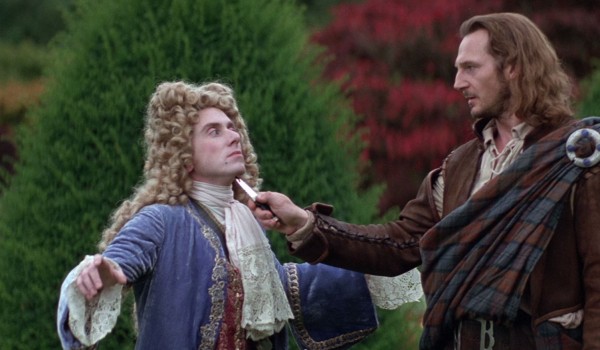
Tim Roth as Archibald Cunningham (left) and Liam Neeson as Rob Roy (right). I can’t remember precisely when this moment is from in the film, but it’s a safe bet that Rob Roy is ‘defending his honor’ from the smarmy Englishman.

This film is all about ‘honor’, which was quite an important concept to 18th century men -remember that the signers of the Declaration of Independences pledge their ‘lives, fortunes and sacred honor‘ to the cause. ‘Honor’ is actually the last word of the Declaration of Independence. (There’s a very interesting article here on Mount Vernon’s website exploring the changing concepts of honor in Colonial America, from something that was linked explicitly to upper classes, to something that ordinary citizens could have, as well).

In writing this blog post, I’ve realized that ‘honor’ is actually a rather tricky concept to explain or to define. In the 18th century, I think it sort of equates to ‘reputation’. But the way that it was defined also depends a lot on gender. When we think of a woman’s ‘honor’ there’s a sexual connotation and we think of chastity, ‘purity’.

‘Honor’ is defined by Rob Roy in the film as something like morality and ethical conduct. Rob Roy explains to his sons that his ‘honor’ prevents him from ever ‘mistreat(ing) a woman or malign(ing) a man’. It is ‘what no man can give you and none can take away’. It is, in short, his moral compass and system of personal ethics.

Throughout the film, Rob Roy’s code of honor is set against the dishonorable behavior of the nobles who effectively cheat him out of quite a lot of money and engage in other sneaky and also violent actions against him, most notably the aforementioned rape of Rob’s wife Mary MacGregor (Jessica Lange). Yet even that horrific act is part of this larger narrative of ‘honor’. The principal reason that the glib aristocrat Archibald Cunningham (Tim Roth) rapes Mary is to drag Rob Roy out of hiding. Now that his wife has been assaulted, Rob Roy’s ‘Highland honor will have to be satisfied,’ Cunningham remarks.

I actually quite liked this emphasis on ‘honor’ as a theme and how, at every turn, Mary MacGregor’s approach to life is much more sensible and pragmatic. In a way, she’s the foil to Rob and his obsession with honor, even more so than the amoral Cunningham. She sees that Rob’s inability to do or say anything bad about anyone ever, or to do anything sneaky or under-handed at all, will get their family into trouble one day. And, indeed, it does.

Lange gives a dignified and emotive performance as Mary – I really believed that she was a sturdy lady who had borne several children, survived rough Scottish winters and was more than capable of stabbing people in the throat (no spoilers, but she may or may not stab someone in the throat).

When the film succeeds, it does so based on the performances of Lange and also Roth, whose despicable character of Cunningham is far more interesting to watch than Rob Roy ever is, because – unlike Rob – he has flaws (quite a lot of flaws – he’s a murderer, rapist, thief, abandons his pregnant girlfriend, only cares about money etc.). Rob seems to already BE a folk hero – always doing good, always caring for others – not someone whose actions inspired legend.

Another area in which the film succeeds is the choice to show extended sword fighting sequences which were really marvelous to watch. Roger Ebert apparently called one of these sword fighting scenes ‘one of the great action sequences in movie history’ and I’d buy that. The final climactic sword fight is long (ten minutes?) and tense – lots of intricate choreography.
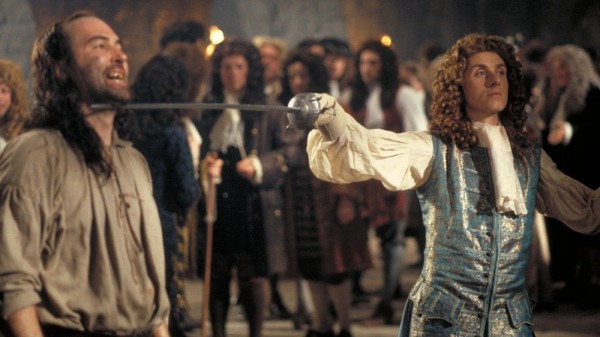
Tim Roth as Archibald Cunningham (right) shows off his fancy sword fighting skills

The landscape is also, of course, breathtaking and it gets plenty of screen time. The whole thing was shot on location in the Highlands and you can absolutely tell. I can’t fault Michael Caton-Jones on the direction – he gets good performances out of his cast and really lets the setting shine.

So would I recommend it? Well, if you’re a fan of Braveheart or Outlander or be-kilted dudes, you’ll certainly like this. And if you’re someone, like me, who enjoys 18th century history and sweeping period dramas, in general, then there’s plenty here to like. It’s just nothing special, largely because of the lack of humanity in the central character. When someone is such a good person, a righteous person, a caring person, they eventually stop seeming like a person, at all.

Let me know what you think of this movie, if you’ve seen it. If not, let me know if it sounds like your cup of tea (or dram of whisky)!

Recommended Reading:

‘Madeira Mondays’ is a series of blog posts exploring 18th century history and historical fiction. Follow the blog for a new post every Monday and thanks for reading!
 

Madeira Mondays: National Treasure (Film Review)

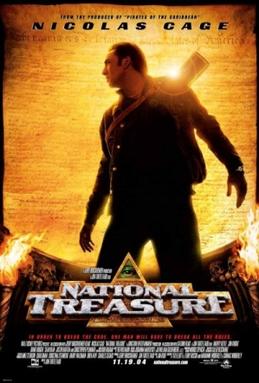
‘I’m gonna steal the Declaration of Independence.’ – Nicolas Cage as Benjamin Franklin Gates in National Treasure

National Treasure (2004) is a deeply silly movie.

It’s a movie that I vividly recall watching at the cinema in my hometown of Austin, Texas. I was around thirteen at the time, and, even at that age, I knew it was silly. It’s the story of American history buff/treasure hunter Benjamin Franklin Gates (Nicolas Cage) who figures out that there is an invisible map on the back of the Declaration of Independence and decides to steal it before it falls in the hands of some baddies. What follows is a race against time as the FBI, and the baddies, try to track down Cage before he can decode the map and find the treasure of the Knights Templar (?), which has been hidden by the Freemasons (???). It’s a very Dan Brown-esque story (conspiracy theories, hidden ‘clues’, secret societies etc.).

Movie_national_treasure

So when I decided to rewatch this for ‘Madeira Mondays’ (as part of my 4th of July inspired series of posts), I had one question in mind: Is this a fun enough watch that I would recommend it? Is it ‘good bad’ (i.e. so bad it’s actually funny to watch)? Or is it genuinely ‘good’ (i.e. works on the intended levels, as a satisfying action/adventure story?). Sadly, it falls somewhere in the middle and was, overall, pretty dull and too long. Which is disappointing, considering that it’s a story about a treasure hunt and I like most of the actors in it.

One of the things that keeps it from being ‘good bad’ is that the actors are actually too talented for it to really suck. Nicolas Cage is incredibly deadpan throughout the whole thing, and he has such a bizarre and unique charisma that it kind of works somehow. His love interest, Dr Abigail Chase (Diana Kruger) also works as a somewhat cerebral archivist who is both annoyed and intrigued by Gate’s treasure hunting antics (I also liked the choice to make her a German character – the actress is from Germany. There’s a good line when Gates notices her slight accent and asks: ‘You’re not American?’ And she says: ‘I am an American, I just wasn’t born here.’ Nice). And how could Sean Bean not work as the baddie (I’ve already forgotten his character’s name) obsessed with finding the treasure (guess he gave up trying to get The One Ring. Sorry! I had to make a Lord of the Rings joke!). These people are too talented for the film to really and truly stink.

National Treasure

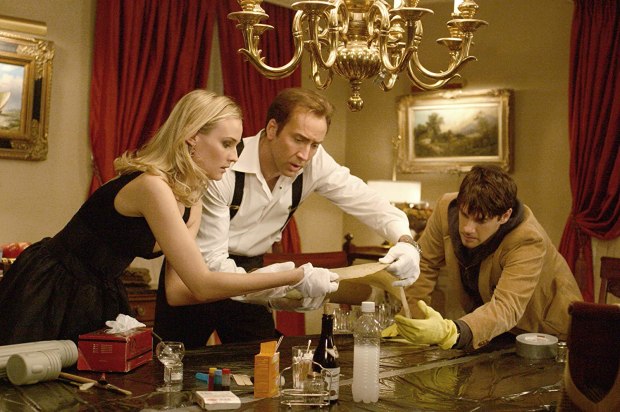
Dr. Abigail Chase (Diane Kruger), Benjamin Gates (Nicholas Cage) and Justin Bartha (Riley Poole) defacing the Declaration of Independence in order to find a hidden treasure map on the back, Image accessed via IMDB

Also, I enjoyed that even the names in this are silly and on-the-nose. Mr. Gates is a treasure hunter, alongside Dr. Chase.

I also enjoyed the film’s fairly bonkers thesis statement, which is basically that extralegal things are totally okay sometimes, if you do them for the right reasons. Gates draws a hilarious parallel between himself and the men who signed the Declaration of Independence (which he correctly identifies as ‘high treason’ at the time), by saying that both he and they are doing something that is against the law, but they are doing it for the right reasons. The movie isn’t self-important enough to take this thesis very seriously, or to really interrogate this concept of when it is ‘okay’ to break the law, if you believe the laws are unjust. That’s not what we’re here for. We’re here to see Sean Bean blowing up a 300 year old pirate ship (which is something that happens in this movie).

I’m not even going to touch on the ‘historical accuracy’ of this movie, because the movie clearly doesn’t care about that. But I don’t think you’ll come away with it having learned anything ‘accurate’ about early America (except maybe that the founders, by signing the Declaration, were doing something illegal at the time and would very much have been executed if they had lost the rebellion, as Gates points out).

So, sadly, I’d say don’t bother with National Treasure. Unless you are a particular fan of Dan Brown type stuff, or you love Indianan Jones and you want a somewhat crappier version of that. But, all in all, if you want a ridiculous movie about early America, I’d actually direct you to Beyond the Mask (which I reviewed earlier this year), which is an independent ‘Christian’ movie about an outlaw during the Revolutionary War (think: budget Zorro) and is much sillier, stranger, and ultimately a funnier watch than National Treasure.

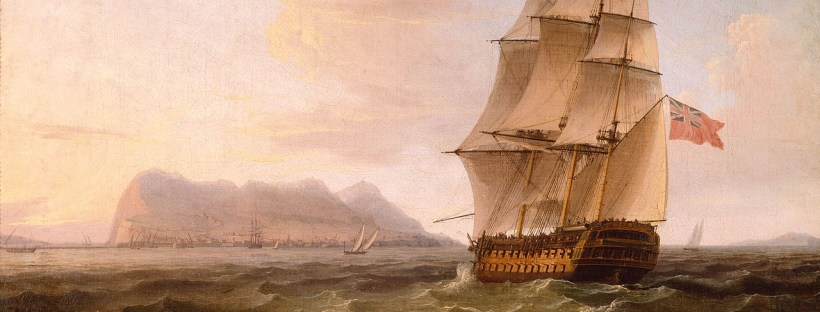
PS Today’s Featured Image is ‘A British Man of War before the Rock of Gibraltar’ by Thomas Whitcombe, created in the late 18th/early 19th century, accessed via Wikimedia

‘Madeira Mondays’ is a series of blog posts exploring Early American history and historical fiction. I’m not a historian, but an author and poet who is endlessly fascinated by this time period. I am also currently writing/researching a novel set during the American Revolution and recently finished a Doctorate of Fine Art looking at how creative writers access America’s eighteenth-century past. 

Follow the blog for a new post every Monday and thanks for reading!


Madeira Mondays: Portrait of a Lady on Fire (Film Review)

France, 1770. A tale of forbidden love, same-sex desire and painting. Sign me up! From the moment a friend of mine sent me the trailer for Céline Sciamma’s new film, Portrait of a Lady on Fire (or Portrait de la Jeune Fille En Feu, in its original French), I knew I would enjoy this movie. It ticks so many boxes of things I enjoy. It’s historical, it’s a bit gothic, it’s about female experiences and patriarchal limitations. I’m also a sucker for art about art. So I went into it with pretty high expectations. But what I did not expect was just how good this film was: it’s a subtle, sensuous, and frankly pretty faultless movie. It’s also just so. darn. romantic. And tragic. But we’ll get to that in a second.

portait of a lady

As I mentioned, the film takes place in France in the 1770’s (which, by the way, is the exact same time period in which the novel I am working on is set – so I loved seeing the costumes in this!). It follows a small cast of characters. Marianne (Noémie Merlant) is a painter, newly arrived to a drafty old mansion on the Brittany coast. She has been called there to paint Héloise (Adèle Haenel), a young aristocratic woman who will soon be married off to a Milanese nobleman. The painting will be a gift to this man, a lovely portrait of his new French bride. The only catch is: Héloise doesn’t want to have her portrait painted at all. She doesn’t want to be married off, either. So Marianne must paint her subject in secret, observing her with furtive glances on their walks on a windswept beach, or by the steep cliffs. Is there tension? You bet there is! Are those pauses pregnant with longing and unspoken words? You bet they are.

This is a film that is especially suited to its medium and by that I mean it’s a very visual film. Don’t get me wrong: the dialogue, when it happens, is excellent. Funny and specific and gives a great sense of character. But it’s a lot about looks, as slowly Marianne’s portrait of the surly but also surpassingly sweet Héloise emerges. But Héloise is also looking back at Marianne, observing this young woman who, unlike herself, has a professional career as a painter and has decided not to marry. Marianne wears masculine clothes and smokes a pipe (although this is not entirely uncommon for women of the time). Marianne is well-travelled. She’s heard symphonies. Héloise is entranced. They’re entranced with each other.

portait of a young girl

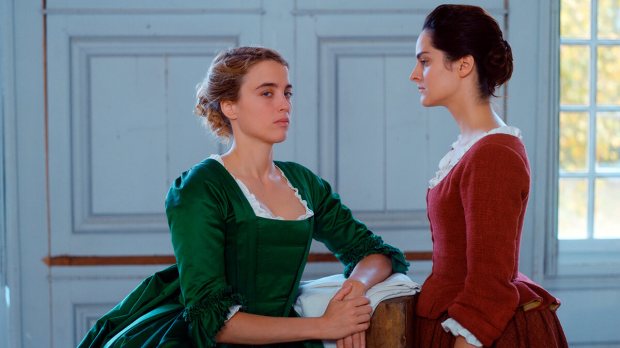
Marianne (Noemie Merlant), right, and Heloise (Adele Haenel), left.

I don’t think it’s giving too much away to say that these two fall in love (it’s made obvious in the trailer). At its heart, this film is a love story. But what I like most about the film is that we are made constantly aware – through their romance, through Marianne’s career (which is limited due to her sex), and through a sub-plot with Sophie (Luàna Bajrami), Héloise’s servant who falls pregnant on accident – that their lives are governed by patriarchal rules. Marianne casually mentions that she cannot draw nude male models, only female ones, because female artists are not allowed to observe naked men. ‘Is it a matter of modesty?’ Héloise asks. Marianne replies: ‘It’s mostly to prevent us from doing great art. Without any notion of male anatomy, the major subjects escape us.’

This is great. Sciamma doesn’t have to make Marianne say: ‘We’re oppressed! We’re women! It’s an unequal society!’ We just know from these examples.

I don’t want to come down too hard on Greta Gerwig’s recent adaptation of Little Women, which I liked for certain reasons, but it’s also concerned with limitations faced by women of the past, when trying to enter the public, professional world. And it definitely hits you over the head with these sorts of inequalities more overtly than Portrait does. Think of the speech that progressive artist Jo March makes in Gerwig’s Little Women:

I just feel that women, they have minds, and they have souls, as well as just hearts. And they’ve got ambition and they’ve got talent, as well as just beauty. And I’m so sick of people saying that love is all a women is fit for. I’m so sick of it. But I’m so lonely.

This is a good speech and delivered exceptionally well by Saoirse Ronan, but all of those same sentiments were encapsulated in Portrait, without needing to be directly said. This film is subtle and understated in all of the ways that I felt Little Women was not. And, granted, Little Women was a much cheerier, lighter, brighter, film overall. Whereas Portrait is more turbulent, moody, subtler, holds a lot more back. (Little Women is an American film, after all, and Portrait is a French one haha!). But still. They came out at almost the same time and explore many of the same themes, which is why I’m comparing them.

ANYWAYS, if you like these types of stories (about women who are ‘ahead of their time’, about forbidden passions, about slightly creepy mansions on windswept coasts), then you’re gonna LOVE Portrait of a Lady on Fire. While Portrait didn’t blow my mind – I don’t think it was doing anything exceptionally innovative or treading on especially new territory – I still think it was an excellent film. I cried several times. It’s also definitely one of the best films I’ve ever seen set during this time period, so if you’re looking for a brilliant, subtle, well-crafted historical film, then do check it out!

(PS All of the images in this post, including the gorgeous waves-crashing Featured Image, were accessed via IMDB)

‘Madeira Mondays’ is a series of blog posts exploring Early American history and historical fiction. I’m not a historian, but an author and poet who is endlessly fascinated by this time period. I am also currently writing/researching a novel set during the American Revolution and recently finished a Doctorate of Fine Art looking at how creative writers access America’s eighteenth-century past. Follow the blog for a new post every Monday and thanks for reading!