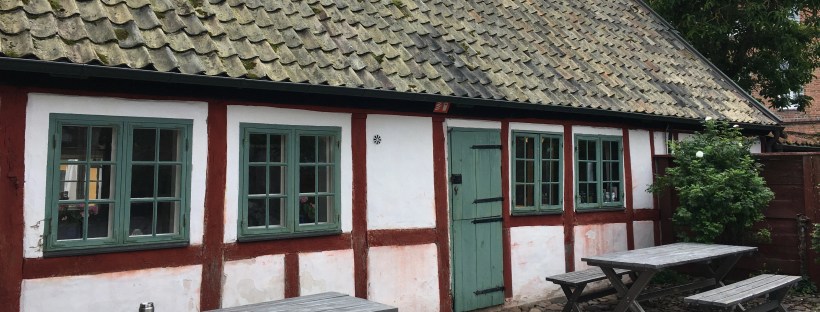
As regular readers of this blog will know, I’m absolutely fascinated by how people lived in the past. It’s one of the reasons I read and write historical fiction, it’s why I volunteered as a historical guide at a restored 18th century townhouse and it’s why – whenever I get the chance – I love visiting historical buildings and museums.
My favorite type of museums are open-air museums (or ‘folk museums’) where you get to go inside a collection of historical buildings, which are usually full of objects and sometimes even costumed guides. These are my favorite museums because they are immersive and really give you the feeling of ‘stepping back in time’.
I’ve been to Skansen in Stockholm (the world’s oldest open air museum, opened in 1900), Colonial Williamsburg in the USA, and even an open-air museum in Transylvania (though that’s a story for another time!). Longtime blog readers might also remember The Highland Folk Museum. Earlier this month I had the pleasure of traveling to beautiful southern Sweden (my partner’s brother lives there). When we found out there was an open air museum – Kulturen – located in the nearby university town of Lund, we knew we had to go!
I wanted to start off by saying: Lund itself is like a living history museum. It reminded me a little bit of Cambridge in England (and, for that matter, Cambridge in Boston). There were lovely historical buildings everywhere, many of them red brick, and it had a very idyllic, university-town feel in contrast to the hip and modern city of Malmo nearby (more on that in a future post!). Just walking down the street you’re met with lovely coffee shops in what must be converted old brick houses – it’s a pleasure just to stroll around.
Here are a few shots I took of interesting buildings while just meandering down the cobblestoned streets in the center of town.


Kulturen itself is nestled right in the center of the town, near the cathedral, and it has both historical buildings and several indoor museum sections. There’s also a very nice restaurant/cafe in the courtyard in front of the museum where we had a delicious lunch. Their website says: “Step right into the buildings to experience life as it was in former times in either the town or countryside, from the Middle Ages up to the 1930s.”
We started with an exhibition called Rooms of Time focused on the development of the home from about the 1500s through today. This was a more traditional museum exhibition, so you were looking at displays of furniture behind a glass wall. And while this was interesting, and we did learn a few new things, there wasn’t a ton of information in English so that made it a little harder for us to interact with. (This definitely surprised us, because in Sweden pretty much everyone speaks English and all the museums we’d been to before had tons of information in English). It’s fine for things to be more geared towards local audiences, but for us international travels, this was our observation!
That being said – I became totally obsessed with these tile fireplaces in the 18th century portion of the museum, which were apparently a staple in Swedish homes during that time. I’d never heard of them before even though this is ‘my era’ but it just goes to show how geography can play such a big role in how people live. In the UK and the USA it probably doesn’t get as cold as parts of Sweden!

After this exhibit, we had our ‘fika’ (a Swedish afternoon coffee and cake break, which I love !) and then explored some of the actual ‘open air’ museum buildings – the historical buildings from Sweden’s past. These were cool, but again there wasn’t a ton of information about them (in English or Swedish) and I was intrigued but left wanting a little bit more!
Many of the old buildings weren’t originals but recreations – which is fine and sometimes necessary. But there was also a little bit of information about how these buildings were made to look like they did when Kulturen opened in the early 1900s, so it became a bit of a display about the history of the museum, rather than just local history.

What we shortly discovered is that where Kulturen really shines is in some of the indoor museum exhibitions – there was a wonderful display of women’s dresses from about the 17th century through to the 1990s – and one of the most elaborately designed exhibitions I’ve ever seen, which focused on modernist art! I forgot to take photos but there are some here. My partner pointed out that the modernist exhibition really managed to tie in the local (Lund artists) with the larger modernist art context.
Aside from a somewhat disappointing (but very aesthetically pleasing!) display of Scandinavian designed kitchenware, we were impressed more with all the indoor exhibitions (especially the modernism one) than the outdoor, living history stuff.

I should say: I’m a ‘tough costumer’ when it comes to these sorts of museums, and perhaps museums in general. I’ve been to a lot of them, and I really try to pay attention to how information is set up, displayed and communicated. My partner actually did ‘museum studies’ at university – he’s a film critic now, but what I’m trying to say is that even though our experience was a mixed bag, it doesn’t mean yours would be. I think if we’d gone on a tour in English, which they do offer sometimes, it would have been a lot better. Also, I think I was comparing it in my head to Skansen in Stockholm which is just SO much bigger than this in every sense. It’s not really fair to compare them.
So I would absolutely recommend a visit to the picturesque city of Lund if you’re in Sweden. And, if you enjoy museums, there will be plenty for you to see at Kulturen. We actually went back a second day – there’s lots to do. There’s even a pretty garden where they grow fruits and veggies. And if you enjoy modernist stuff then boy howdy – you’re about to be in for a real treat! But if you love folk museums specifically, I wouldn’t rate this as one of my favorites sadly. Definitely worth a visit if you’re in the city though (and check out the restaurant if you have time! Delicious seafood stew!)
Madeira Mondays are a series of blog posts all about history and historical fiction. This October marks four years (!) of Madeira Mondays. Let me know in the comments how long you’ve been following along!
You can support this blog by buying me a coffee on Ko-fi (thanks to those who do!).
I start a new job this month as a full-time Lecturer in Creative Writing at the University of Glasgow. Yay! That doesn’t mean these posts will stop though. I will still endeavor to post on the first Monday of each month! But if you enjoy the blog and want it to continue, I’d invite you to subscribe to it, like, comment or support it on Ko-fi. To be very frank, the more enthusiasm there is for it – the more likely it is I’ll be able to keep going alongside my new job and other creative projects.
A huge thanks, as always, for reading! xx
 Carly Brown
Congrats on your new job! Thanks for the tour of Lund. Glad to see you’re thriving.
LikeLiked by 1 person
Thank you so much! Lovely to hear from you. Hugs to you, Michael and Fiona!!
LikeLike
I love those kind of museums too, and now I know what you call them! It always sparks my imagination in fun ways.
And congrats on the new gig!
LikeLiked by 1 person
Thanks Nancy! Yes these sort of places definitely spark the imagination for me too, even more than ‘ordinary’ museums. Hope you’re doing well! 🙂
LikeLike