Madeira Mondays: My favorite view in Edinburgh (Calton Hill)

A lot of folks visiting Edinburgh make time to climb Arthur’s Seat. And don’t get me wrong, that’s a beautiful hike with a rewarding view at the top. I wrote all about it in a recent post here. But personally, I prefer Calton Hill. It’s got a very interesting and unique history and it offers excellent views that are, in my opinion, comparable to Arthur’s Seat. Of course, it’s not as tall as Arthur’s Seat, but it does have an observatory and several monuments, including one unfinished monument locally referred to as “Edinburgh’s Disgrace” (more on that below!).

So this post is my “pitch” if you will for why you should visit Calton Hill if you’re in Edinburgh, alongside a bit of history about this unique landmark.

“Edinburgh from the Calton Hill”, David Roberts, 1858

One of the best things about the hill is that it’s smack dab in the center of the city. It’s basically right at the end of Princes Street (the city’s main shopping thoroughfare). And it only takes about five minutes to walk up the steps from the street to reach the top of the hill, making it the perfect place for quick access to amazing views (Arthur’s Seat, by comparison, takes about half an hour or more to climb, depending on what route you take up).

And what will you see when you get to the top? Well, quite a lot!

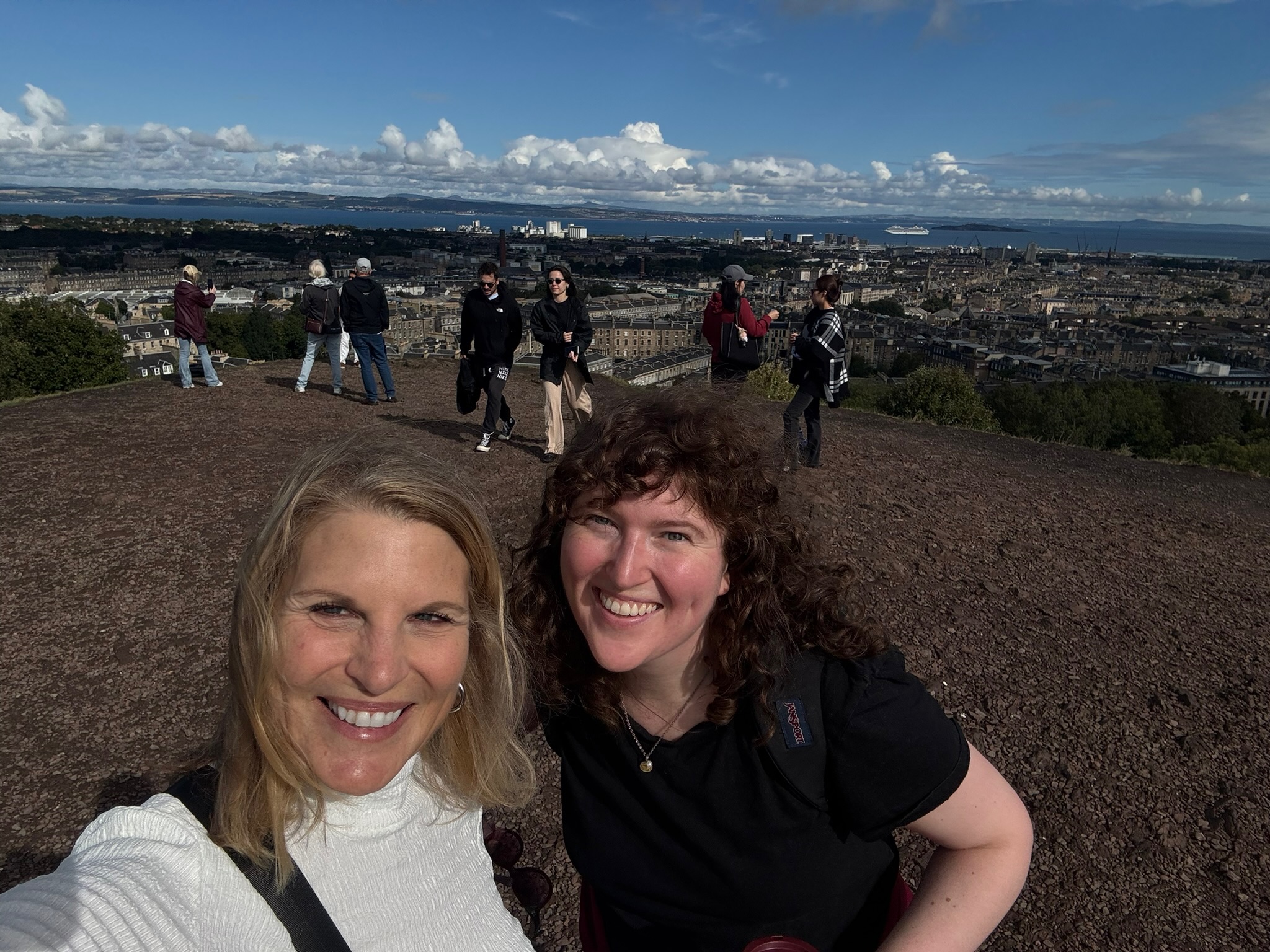
If you look north, you’ll see the Firth of Forth (the body of water separating Edinburgh and Fife) and the neighborhood of Leith, along other things. Here’s my mom and I on a recent walk up there, taking in those views.
And looking south (forgive me if my directions are off, but I’m pretty sure it’s south!), you’ll see the rest of the city, including the castle.
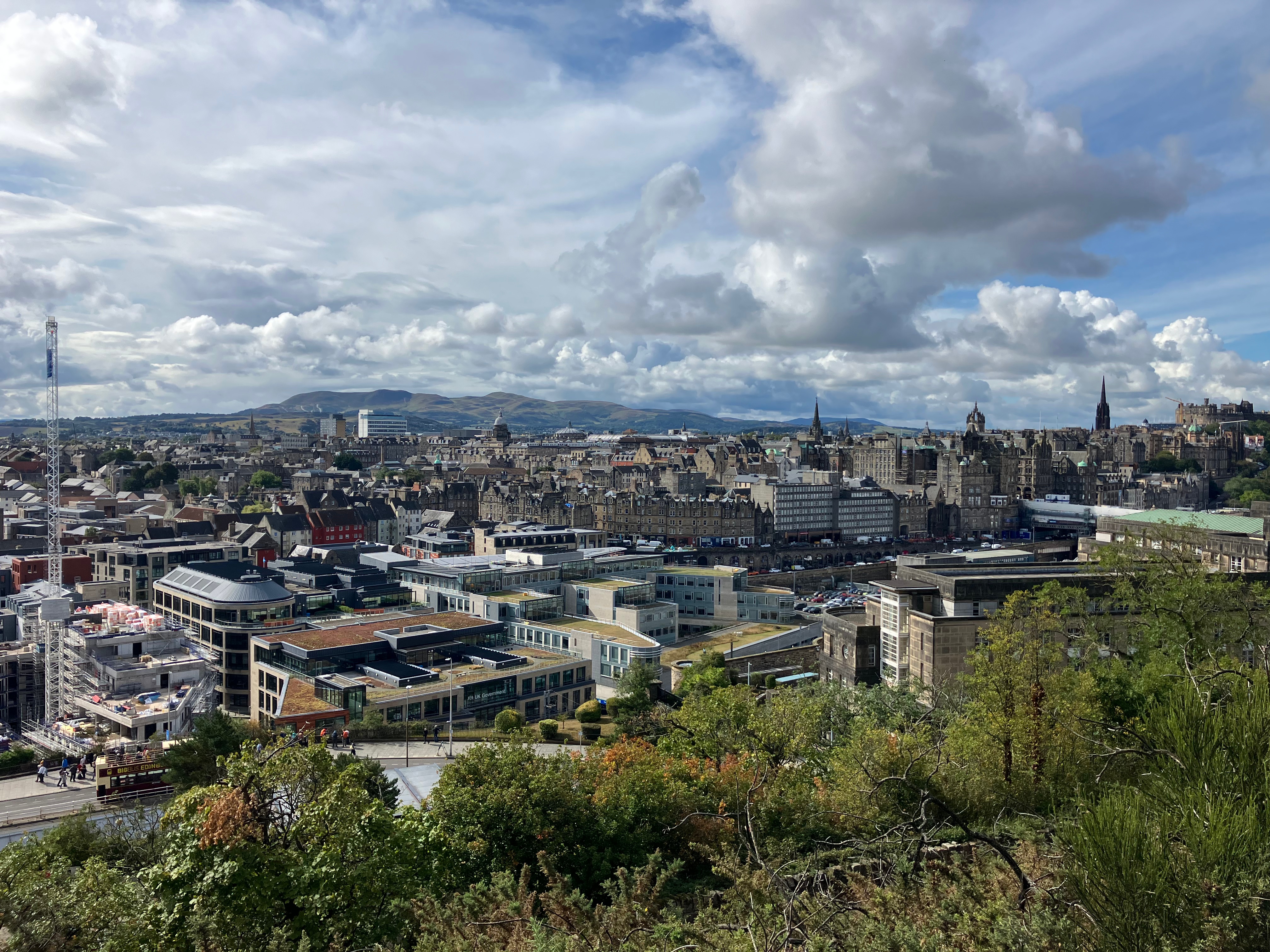
You can spot the castle in the far right of this image, and I’ve included a close up shot below

And not far from the base of the hill, you can also spot Holyrood, the palace where the King stays in Scotland.

(If anyone is interested in a Holyrood focused post let me know because that is a really cool place to visit, with lots of history about Mary Queen of Scots!)

The Palace of Holyrood viewed from Calton Hill

Basically, you can wander around the hilltop and, in every direction, there’s a great view!

But there’s more to see up there then just a fantastic view, including the National Monument.

To understand what makes this monument so quirky, you have to know that, in the 19th century, and even sometimes still today, Edinburgh was referred to as the “Athens of the North”. So Calton Hill was meant to be our answer to the acropolis. The famous (and unfinished) national monument was meant to be like the Parthenon in Athens. Construction began in 1826 and it was intended to commemorate the Scottish servicemen who died fighting Napoleon. But building halted just a few years later sadly due to lack of money and it was never finished.

So now you just have these columns basically – an incomplete monument.
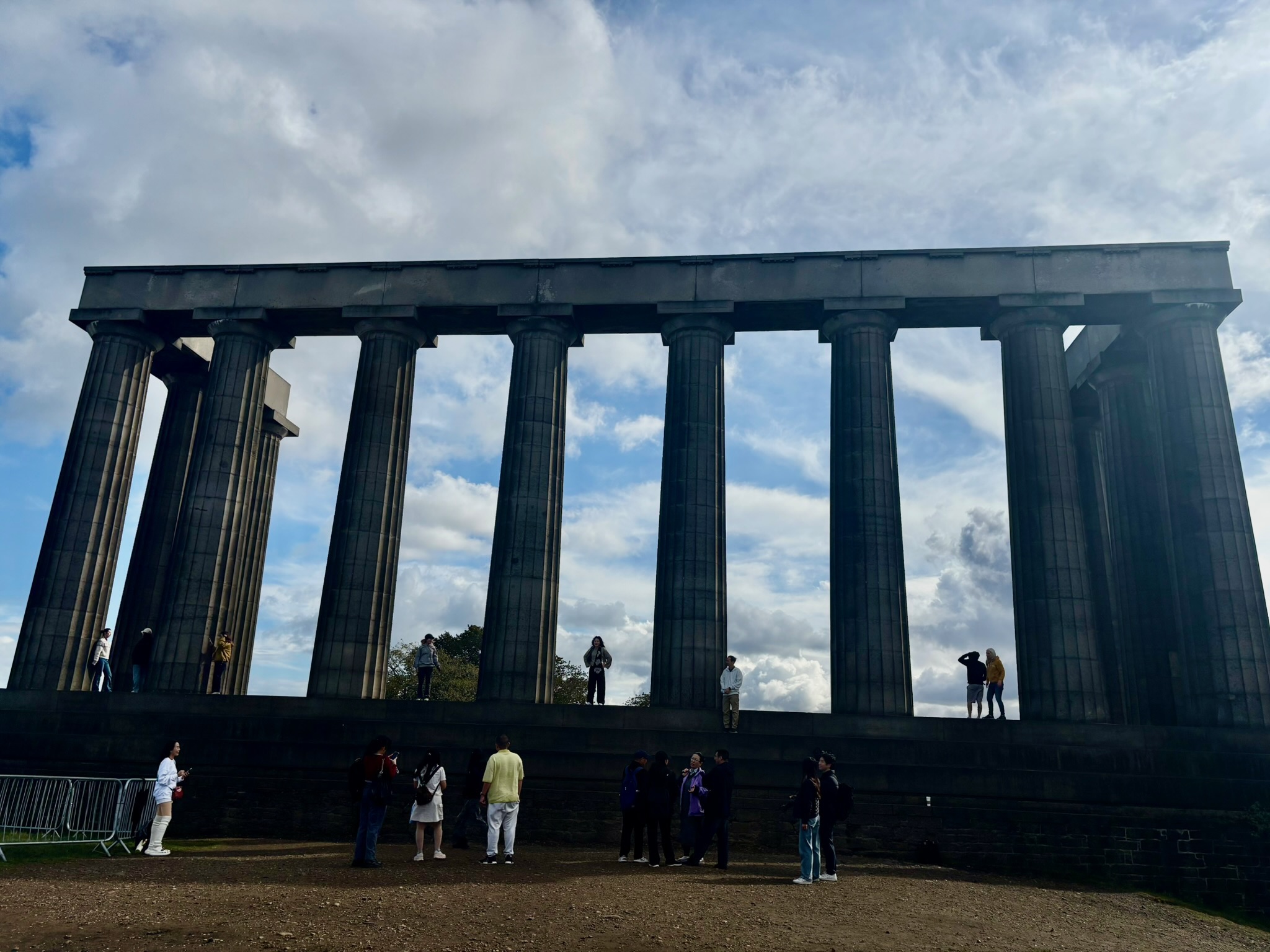
But I personally really like the look of it and my mom made a good point when she visited recently that, for the average traveler nowadays, you wouldn’t know the difference between an “incomplete” monument and one that is just missing parts due to age or wear and tear. It looks like a relic from a bygone era, and it certainly is that. Its incomplete nature seems less serious now then it probably did back in the day, when their big dreams were crushed due to the lack of big funds. Now it’s simply a beautiful and iconic part of the skyline.

You can see other elements of neoclassical architecture up there too, including the City Observatory (which I want to make a whole separate post on) and the Dugald Stewart monument (he was a Scottish philosopher). I also like the Nelson monument up there, for British naval hero Horatio Nelson, a stone tower that forms another memorable part of the skyline.

One of the things I like most about this city is that it’s definitely urban but it has a very peaceful, almost countryside feel, embodied by places like Calton Hill. You will know this if you’ve visited, but there are green spaces throughout. I love this. I think this, mixed with all the historical architecture (18th and 19th century and earlier), makes it one of the most beautiful cities in the world.

And Calton Hill is one of the best places to take everything in and to perhaps remember that even projects that don’t go exactly the way you planned can still turn out beautiful.

You can find out more about Calton Hill and its history on the Edinburgh World Heritage Site here. For some amazing photos and more information about the hill, check out this helpful blog post, “A Local’s Guide to Calton Hill, Edinburgh”.

And finally, because it’s the last post of the year, I just wanted to thank you for reading! And to share that I got to have a very special experience this year: I met one of this blog’s readers in person in Edinburgh! She was visiting with her husband and we had a fantastic time grabbing a drink at a local pub, Cafe Royal. This is a positive side of the internet – meeting interesting, like-minded people and forming friendships.

Getting drinks with writer and fellow 18th century history enthusiast: Kristin!

I hope you have a nice festive period and I’ll be back in January!

Madeira Mondays are posted on the first Monday of every month and explore history and historical fiction. If you enjoyed this post please share it, subscribe to the blog, or you can support the blog by buying me a coffee on Kofi! There are many more historical adventures and journeys to share, and I thank you so much for reading! 

Madeira Mondays: Meeting the Infamous Burke and Hare

I’m not a big fan of true crime. I have several friends who love nothing more than listening to podcasts and watching shows about serial killers, or mysterious disappearances, or unexplained grisly crimes. Occasionally one will suck me in (one of the first podcasts I ever listened to was This American Life’s original Serial series, back in 2014), but in general this kind of media isn’t for me. Maybe it’s because I’m already a bit of a scaredy cat. Maybe it’s because of the morally confused way I always feel when I’m “enjoying” stories about real people’s suffering (for a darkly comedic take on the ethics of true crime podcasts, I’d highly recommend the movie Vengeance written and directed by B.J. Novak. It’s underrated and very thought-provoking!).

Nevertheless, there are some famous crimes and criminals that seep into the public consciousness whether you seek them out or not. And, if you live in Edinburgh, you’ve definitely heard the names Burke and Hare. They are often referred to as “body snatchers”, but I’ll talk below about why I think that term is misleading and also about my recent experience of seeing the actual faces of Burke and Hare (ek!) at the National Portrait Gallery a couple of weeks ago…

Continue reading

Madeira Mondays: The National Museum of Cinema (Turin, Italy)

Madeira Mondays is hitting the road for this one, folks! In early January, I headed to Italy to visit my partner’s family (he’s from a town outside Milan). We spent a few days in the nearby city of Turin. Turin is a beautiful northern Italian city, nestled at the base of the Alps, and it’s home to a unique museum: The National Museum of Cinema.

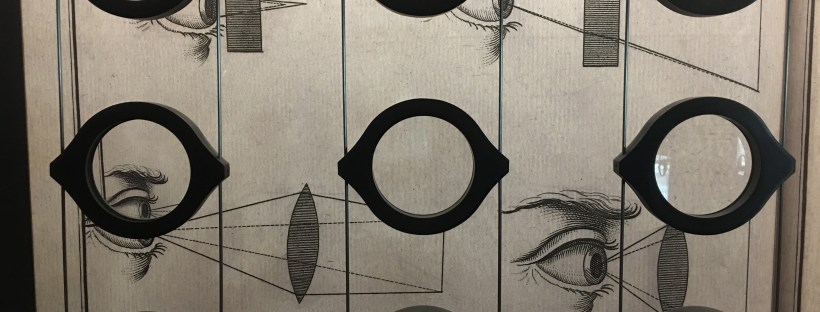
While I was impressed with several aspects of the museum, the coolest thing about it was its collection of old pre-cinema devices, the 18th and 19th century inventions that were popular right BEFORE cinema became a thing. So if you’re wondering what sort of moving images people watched before they went to the movies, then step on into the museum with me…

Continue reading

Madeira Mondays: The Tenement House, Glasgow (Historical Site Visit)

I cannot believe that I lived in Glasgow for several years without ever visiting The Tenement House.

We decided to make the short (about 50 minutes) train ride over to Glasgow from Edinburgh to tour the house as part of my 30th birthday celebrations (slightly hungover from cocktails the night before!).

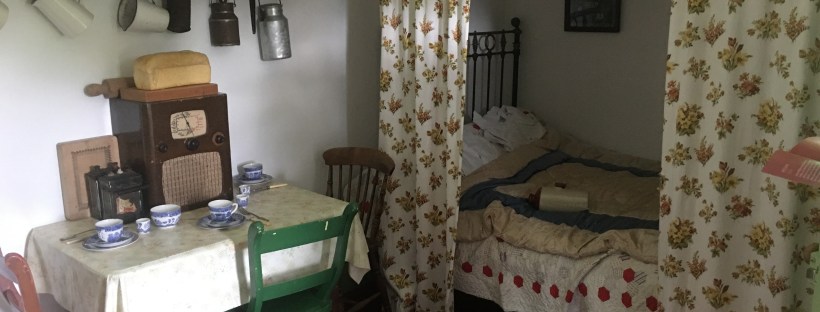
Described on The National Trust website as a ‘time capsule of life in early 20th century Glasgow’, this museum exceeding my expectations and made me (an 18th century lover) very, very jealous at how many wonderful, original items you could see there – including a jar of plum jam made in 1929! The house, located in the very cool Garnetthill area of Glasgow (also home to the Glasgow School of Art, numerous excellent coffeeshops, bars and pretty, residential streets). It was once owned by Miss Agnes Toward, who worked as a typist. She lived there from 1911 until 1965, and the house is full of the belongings of her and her mother. Agnes was a bit of a ‘hoarder’ and kept everything, which is to our benefit, since the house really feels like not only a snapshot of a time but also a quirky, personal archive. That makes the site very special. It’s one person’s home, filled with things they loved.

Continue reading

Madeira Mondays: Return to The Highland Folk Museum

Long-time readers of the blog might remember a post from last summer when I visited The Highland Folk Museum, a wonderful little open air museum nestled in the Cairngorms National Park. Me and my traveling companions were so enthralled with the museum after that first visit that we determined we needed to return, as soon as travel was permitted again in Scotland. So, this June, that’s actually what we did!

If you’ve not had a chance to read that first post about The Highland Folk Museum, I’d recommend it. The property is massive (80 acres) and covered in buildings recreating different eras of Scottish history, from the 1700s through the 1960’s. There is so much to take in. I decided to cover different aspects in each of my posts. That first post covers the recreated 18th century village in the museum, where bits of Outlander was filmed, and where we spent most of our time during our last visit. Whereas this post will be more focused on the rest of the park, which we explored this time around.

This place is so unique and honestly doesn’t feel touristy at all. It truly does give you a slice of Highland life, and how ordinary people used to live. We marveled at not only how detailed all the recreated buildings were (so many little items from frying pans to kettles to quilts!) but also how well kept they were. We didn’t see any dust. Some of the surfaces were even cleaner than my own desk at home! It’s clearly a museum created and maintained with attention, affection and care.

Here are a few of the highlights from our trip this time around…

My favorite thing we saw this time was not actually a building. We were lucky enough to arrive at exactly the moment that they were shearing the sheep! I’ve never seen sheep sheared before and wow – what a process!

Those sheep were thrashing about and it really looked like hard work.

I was surprised that the wool came off in big swathes, almost like blankets, not little tufts.

We got to see the sheep hosed down afterwards with a pink spray, which it turns out was to ward off the flies (who could lay eggs in any cuts the sheep might have gotten, which could then get infected).

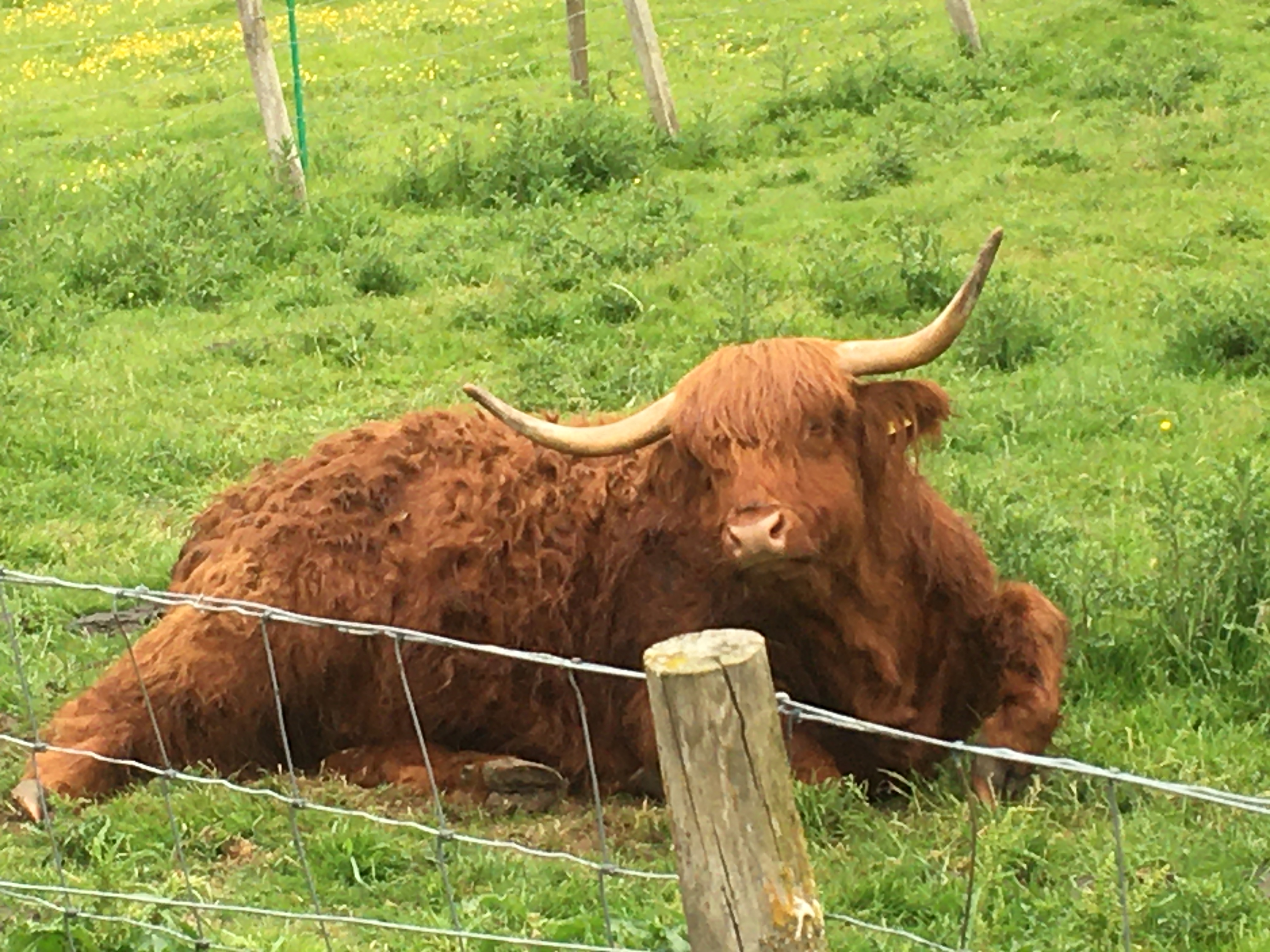
In addition to the sheep, we also met some Highland cows.

We saw so many great buildings too – a recreated post office, railway waiting room, sweet shop, and several homes (most of these were depicting periods from the late 1800s through to the 1950s).

Inside the recreated early 1900s post office

There was also a shinty field and we learned about the history of shinty (an ancient and historically very brutal Scottish sport which is still played now – in a more tame manner! Apparently Scottish emigrants also brought it to Canada, leading to modern ice hockey).

My favorite building that we saw on this trip was a 1930s school house. This was probably my favorite because the guide that we encountered there was so knowledgable about schooling during this period. We heard all about the (usually orphaned) ‘overspill’ children from Glasgow who were shipped away to the Highlands for a ‘better life’ and education in school houses like this. And we heard about the brutal corporal punishments used on students for all manner of offenses, and also about how students were beaten for speaking Gaelic (you had to speak English in schools).

(I appreciated how the guide didn’t sugarcoat any of this, and the Highlands does have a rather sad history: from the Highland Clearances, to forced emigration to the U.S or Canada due to lack of work and opportunities.)

All in all I’m so happy that we travelled back to the Highland Folk Museum and were able to explore it in its entirety. The fact that it’s an open-air museum which allows you to be in the breathtaking landscape as you explore all the buildings is a major bonus. And, in a place where the landscape is so linked to the people, the buildings and the culture, being outdoors is another way to learn about Scotland’s past and present. (And maybe you’d get lucky enough to catch a sheep shearing like we did!)

My recommendation if you visit is to buy a guide book: they’re only a fiver at the door and, without it, you wouldn’t get as rich an experience. There aren’t plaques or explanations outside every building, and, when we visited, not many staff about (possibly due in part to Covid), so it’s basically essential to get the guide, which is packed with great information about how each building was recreated. And I wanted to buy one too: it’s extremely cheap to visit the museum (we only paid a five pound donation total for entry for all three of us!!). We also stopped into the delightful little cafe on site and the gift shop too – wanting to support the work of the museum. (Also, the baked goods were tasty!)

If, like me, you enjoy learning about social history and people’s daily lives in the past, you’ll love this museum. I hope that you enjoyed this virtual ‘visit’, and let me know what you think of it. I’ve linked some info below if you are planning a visit, as well as some more resources if you want to learn more. 🙂

Stay tuned for another Highland-themed post in the next ‘Madeira Mondays’!

Links:

PS Not Highland Folk Museum related, but last week I had the pleasure of being interviewed by the Loud Poets on their wonderful podcast The Loudcast. As most of you know, part of my job is writing and performing poetry, and this interview was an in-depth conversation about my experiences writing for different audiences, bringing empathy and humor to ‘political poetry’ and lots more. They released the podcast episode just yesterday so wanted to pop it here if you’re interested in checking it out!

‘Madeira Mondays’ is a series of blog posts exploring 18th century history and historical fiction. Follow the blog for a new post every other Monday and thanks for reading!

Madeira Mondays: Emily Dickinson’s Poem about Waiting

This isn’t the post I planned on writing today. I planned on writing about the (surprisingly fascinating!) history of ketchup and how it links to international travel and trade in the 18th century. BUT last week was a very full week for me work-wise. So instead of spending today researching ketchup (and don’t worry – that post is coming!), I wanted to share a lovely and timely poem from one of my favorite early American writers: Emily Dickinson.

Emily Dickinson (1830-1886) lived in Amherst Massachusetts and led a quiet, isolated life at home. Although she had only a handful of poems published in her lifetime, she is widely regarded now as one of the great American poets. I wanted to share her poem with you which begins ‘Will there really be a morning?’ (It doesn’t have a title. None of Dickinson’s poems were titled in her original manuscript, so if you ever see one of her poems printed with a title, that was added by an editor).

daguerreotype-cropped-corrected-1

Emily Dickinson, at about the age sixteen or seventeen, in the only authenticated portrait of her after childhood

I’ve not studied Dickinson’s life and work academically, and I’m not sure if there is any known ‘origin’ of this poem (if, for instance, some event in her life is known to have inspired it). But what I do know is that ever since I read it for the first time, it has seemed to me a poem full of yearning, of waiting, of unanswerable questions (‘Will there really be a morning? Is there such a thing as day?’). As the speaker waits for ‘morning’ to arrive, they wonder what morning even is (‘has it feathers like a bird?’). It strikes me that it is the perfect poem to read right now when it seems like we are all waiting: for news, for lockdown to end, for…something. It’s an impatient poem, where the speaker seems desperate for information, calling out for wiser, more experienced people, to reassure them (‘Oh, some scholar! Oh, some sailor!’). And I think all of us can relate to at least some of those feelings and emotions right now.

Here’s the poem:

Will there really be a morning?

Is there such a thing as day?

Could I see it from the mountains

If I were as tall as they?


Has it feet like water-lilies?

Has it feathers like a bird?

Is it brought from famous countries

Of which I’ve never heard?


Oh, some scholar! Oh, some sailor!

Oh, some wise man from the skies!

Please tell a little pilgrim

Where the place called morning lies!

IMG_0481

I hope you enjoyed the poem, and that you’re having a good start to the week.

Would you be curious to have more posts about Emily Dickinson? I was thinking of reviewing the new TV series about her – Dickinson – which came out last year in 2019, and also the comedy film Wild Nights with Emily (2018) which is a queer reinterpretation of her life.

Recommended Further Reading/Viewing:

  • Emily Dickinson: Collected Poems (I’d suggest trying to find an edition where the poems aren’t titled, if possible!)
  • The Poetry Foundation’s page on Emily Dickinson has a lot more info about her life
  • A Quiet Passion, the 2016 film from Terence Davies about Dickinson’s life was pretty good!
  • The Emily Dickinson Museum’s website has lots of info about her too

‘Madeira Mondays’ is a series of blog posts exploring Early American history and historical fiction. I’m not a historian, but an author and poet who is endlessly fascinated by this time period. I am also currently writing/researching a novel set during the American Revolution and recently finished a Doctorate of Fine Art looking at how creative writers access America’s eighteenth-century past. 

Follow the blog for a new post every Monday and thanks for reading!