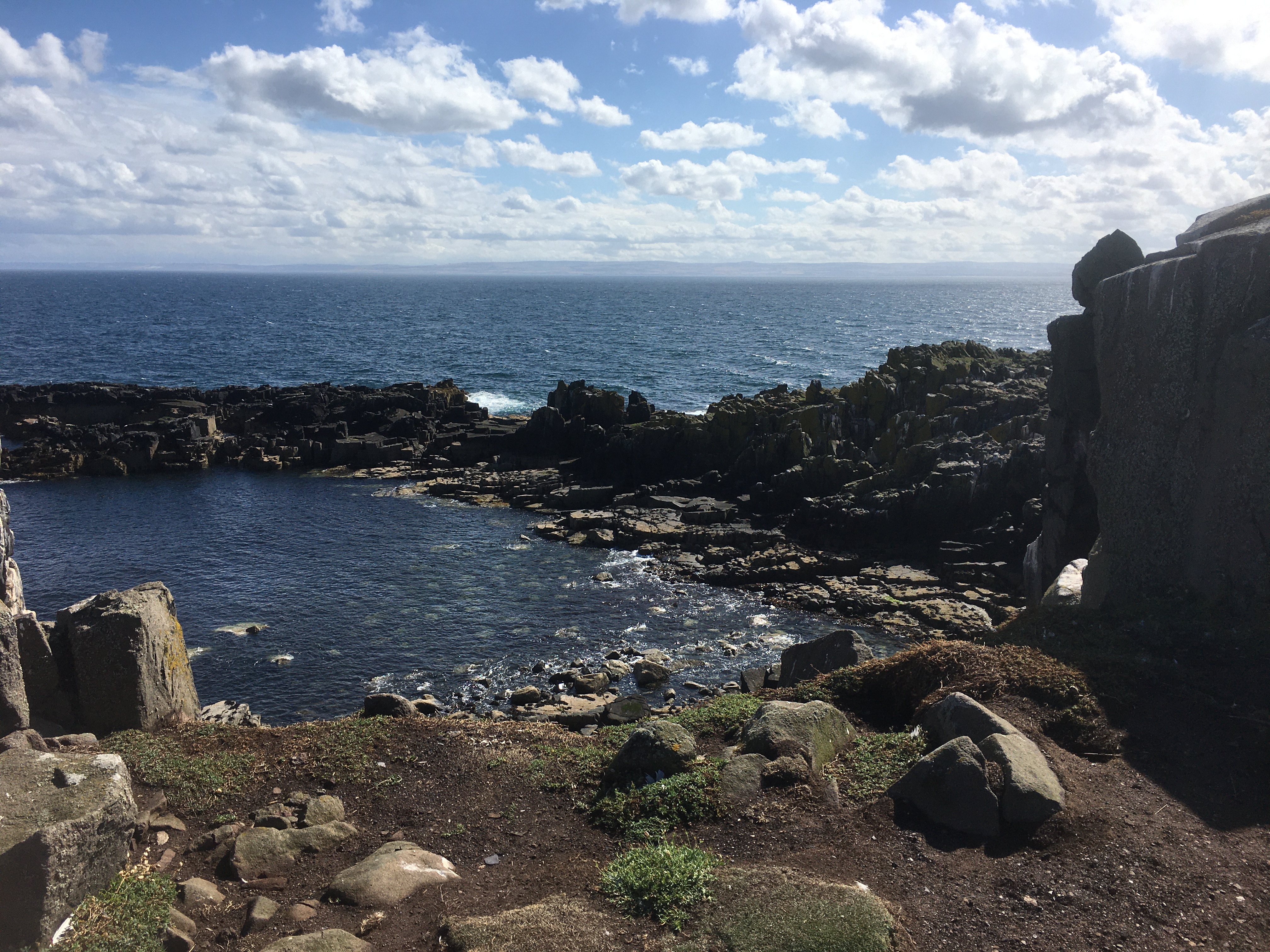
Madeira Mondays: My favorite view in Edinburgh (Calton Hill)

A lot of folks visiting Edinburgh make time to climb Arthur’s Seat. And don’t get me wrong, that’s a beautiful hike with a rewarding view at the top. I wrote all about it in a recent post here. But personally, I prefer Calton Hill. It’s got a very interesting and unique history and it offers excellent views that are, in my opinion, comparable to Arthur’s Seat. Of course, it’s not as tall as Arthur’s Seat, but it does have an observatory and several monuments, including one unfinished monument locally referred to as “Edinburgh’s Disgrace” (more on that below!).

So this post is my “pitch” if you will for why you should visit Calton Hill if you’re in Edinburgh, alongside a bit of history about this unique landmark.

“Edinburgh from the Calton Hill”, David Roberts, 1858

One of the best things about the hill is that it’s smack dab in the center of the city. It’s basically right at the end of Princes Street (the city’s main shopping thoroughfare). And it only takes about five minutes to walk up the steps from the street to reach the top of the hill, making it the perfect place for quick access to amazing views (Arthur’s Seat, by comparison, takes about half an hour or more to climb, depending on what route you take up).

And what will you see when you get to the top? Well, quite a lot!

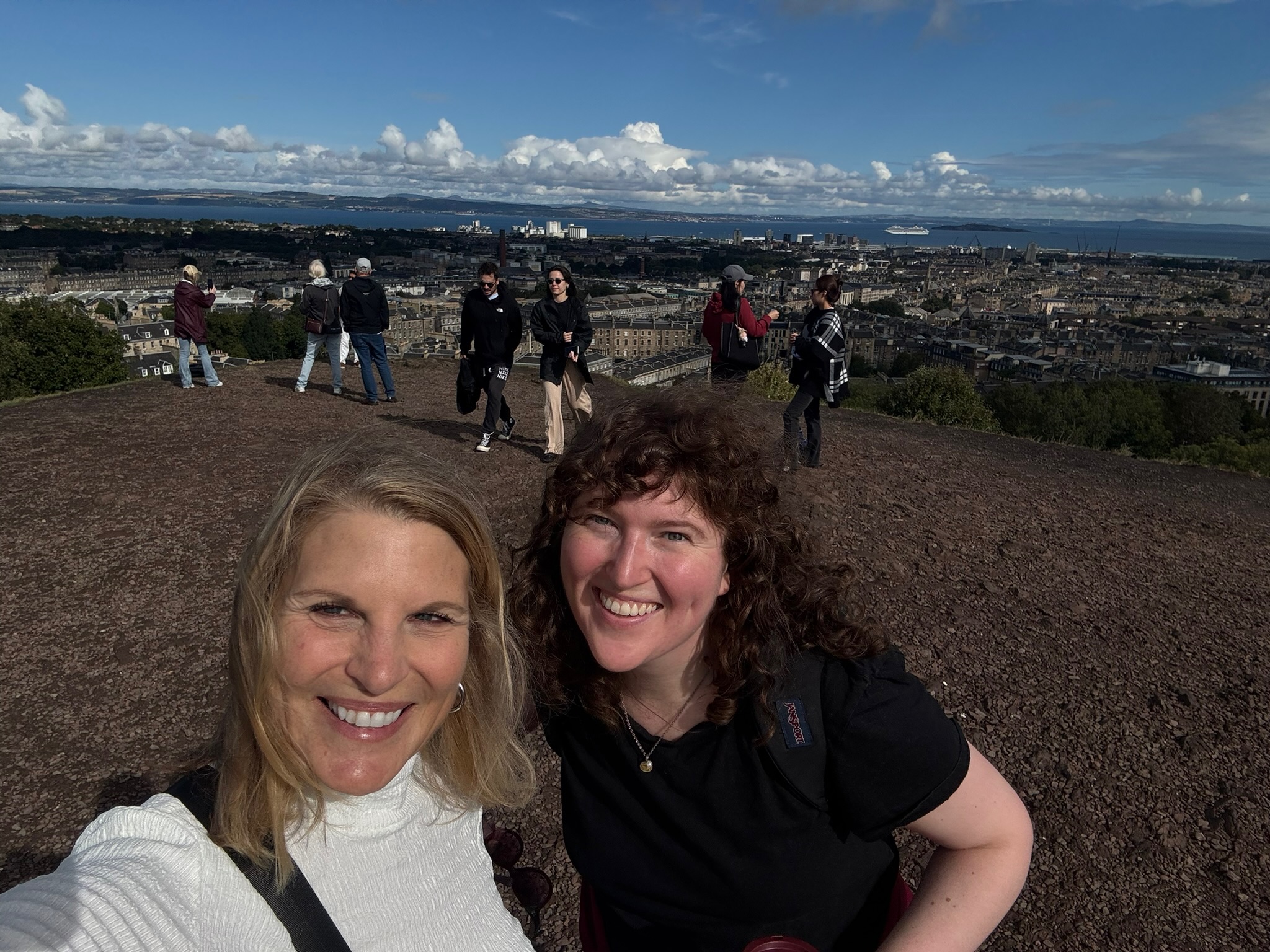
If you look north, you’ll see the Firth of Forth (the body of water separating Edinburgh and Fife) and the neighborhood of Leith, along other things. Here’s my mom and I on a recent walk up there, taking in those views.
And looking south (forgive me if my directions are off, but I’m pretty sure it’s south!), you’ll see the rest of the city, including the castle.
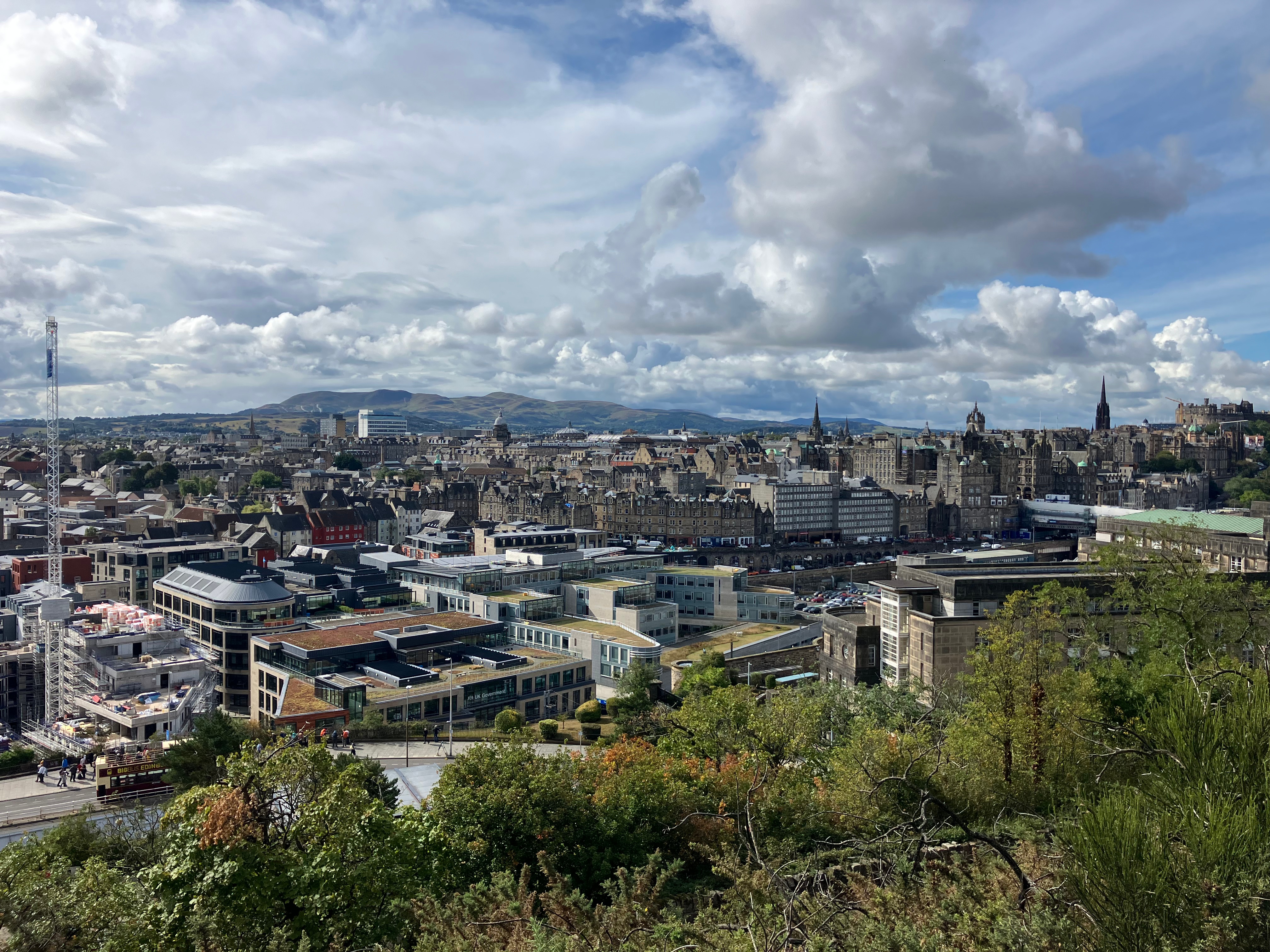
You can spot the castle in the far right of this image, and I’ve included a close up shot below

And not far from the base of the hill, you can also spot Holyrood, the palace where the King stays in Scotland.

(If anyone is interested in a Holyrood focused post let me know because that is a really cool place to visit, with lots of history about Mary Queen of Scots!)

The Palace of Holyrood viewed from Calton Hill

Basically, you can wander around the hilltop and, in every direction, there’s a great view!

But there’s more to see up there then just a fantastic view, including the National Monument.

To understand what makes this monument so quirky, you have to know that, in the 19th century, and even sometimes still today, Edinburgh was referred to as the “Athens of the North”. So Calton Hill was meant to be our answer to the acropolis. The famous (and unfinished) national monument was meant to be like the Parthenon in Athens. Construction began in 1826 and it was intended to commemorate the Scottish servicemen who died fighting Napoleon. But building halted just a few years later sadly due to lack of money and it was never finished.

So now you just have these columns basically – an incomplete monument.
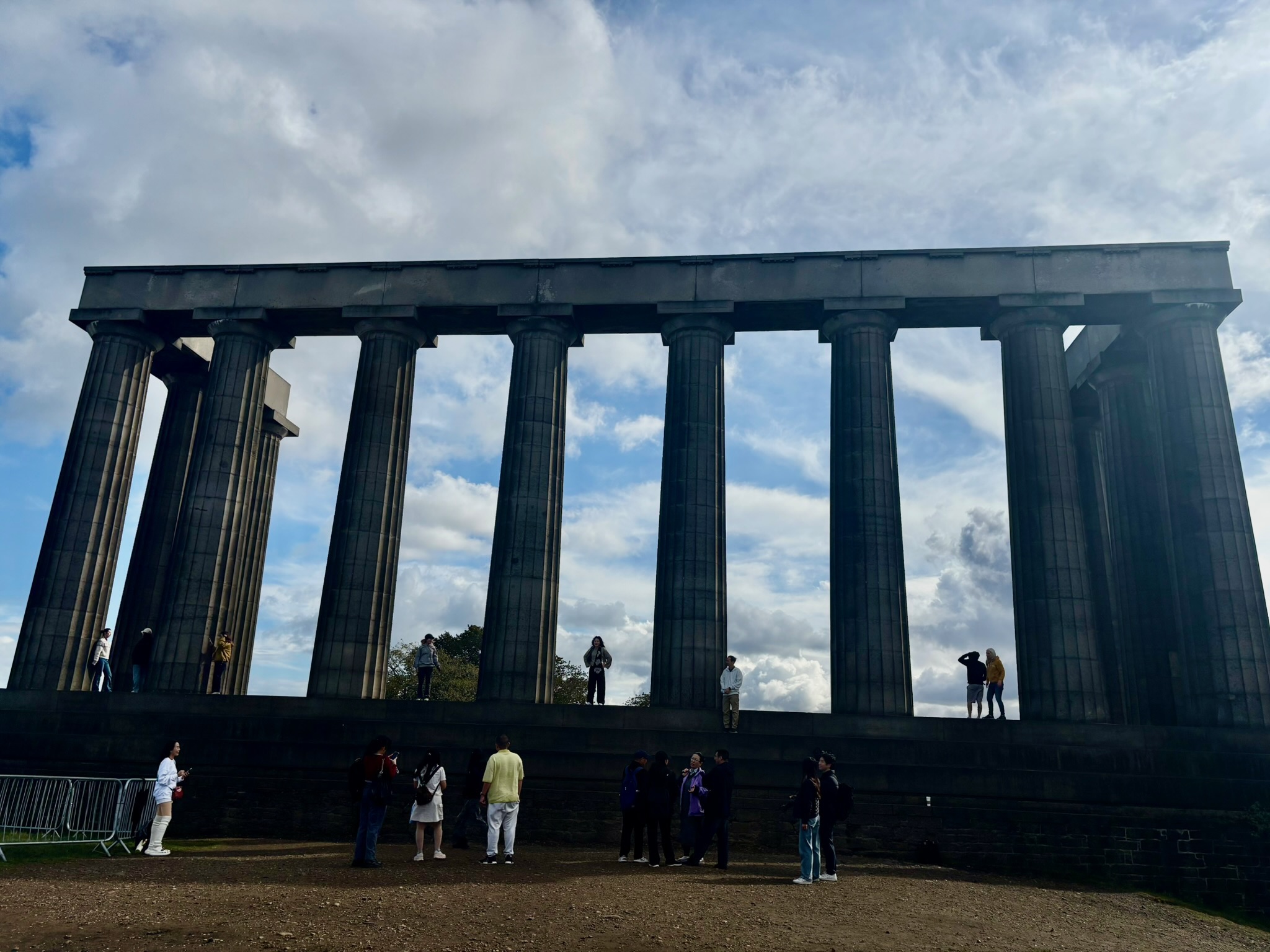
But I personally really like the look of it and my mom made a good point when she visited recently that, for the average traveler nowadays, you wouldn’t know the difference between an “incomplete” monument and one that is just missing parts due to age or wear and tear. It looks like a relic from a bygone era, and it certainly is that. Its incomplete nature seems less serious now then it probably did back in the day, when their big dreams were crushed due to the lack of big funds. Now it’s simply a beautiful and iconic part of the skyline.

You can see other elements of neoclassical architecture up there too, including the City Observatory (which I want to make a whole separate post on) and the Dugald Stewart monument (he was a Scottish philosopher). I also like the Nelson monument up there, for British naval hero Horatio Nelson, a stone tower that forms another memorable part of the skyline.

One of the things I like most about this city is that it’s definitely urban but it has a very peaceful, almost countryside feel, embodied by places like Calton Hill. You will know this if you’ve visited, but there are green spaces throughout. I love this. I think this, mixed with all the historical architecture (18th and 19th century and earlier), makes it one of the most beautiful cities in the world.

And Calton Hill is one of the best places to take everything in and to perhaps remember that even projects that don’t go exactly the way you planned can still turn out beautiful.

You can find out more about Calton Hill and its history on the Edinburgh World Heritage Site here. For some amazing photos and more information about the hill, check out this helpful blog post, “A Local’s Guide to Calton Hill, Edinburgh”.

And finally, because it’s the last post of the year, I just wanted to thank you for reading! And to share that I got to have a very special experience this year: I met one of this blog’s readers in person in Edinburgh! She was visiting with her husband and we had a fantastic time grabbing a drink at a local pub, Cafe Royal. This is a positive side of the internet – meeting interesting, like-minded people and forming friendships.

Getting drinks with writer and fellow 18th century history enthusiast: Kristin!

I hope you have a nice festive period and I’ll be back in January!

Madeira Mondays are posted on the first Monday of every month and explore history and historical fiction. If you enjoyed this post please share it, subscribe to the blog, or you can support the blog by buying me a coffee on Kofi! There are many more historical adventures and journeys to share, and I thank you so much for reading! 

Madeira Mondays: The Prettiest Walk in Edinburgh

If you have been to Edinburgh, you know that it’s a gorgeous city. From the regal stately homes of the New Town, to the old winding medieval alleyways of the Old Town, to the sea at Portobello or the grassy slopes atop Calton Hill, it’s a magical place that offers so many scenic views and interesting pockets of history – it’s hard to choose a favorite part of the city. I called this post ‘The Prettiest Walk in Edinburgh’ because it’s about one of my personal favorite walks I’ve taken in a long time, but there’s really no end to ‘pretty walks’ in a city like this one.

But I offer up this path along the Water of Leith as one of the greenest and most tranquil walks you can take here, also featuring some of the most ‘storybook-like’ parts of the city. So come along if you want a glimpse of that!

Continue reading

Madeira Mondays: How John Adams predicted your 4th of July party

We’re coming up on the 4th of July which is my favorite holiday to explain to my friends here in Scotland. Most of them know that it’s a big celebration in the US but they’re a little bit fuzzy on the ‘why’. If I’m honest, I think some folks in the US are also a little bit unclear about why we celebrate it. Or maybe they remember the general gist of it, but not too many of the particulars.

To put it simply: July 4th, 1776 was the day that the American colonies formally declared their independence from Great Britain. And they declared their independence by signing a document titled, conveniently, ‘The Declaration of Independence.’ This document was mailed to the King who was, understandably, not too happy about it. But who is ‘they’? Who signed this world-changing document?

Continue reading

Madeira Mondays: Ridley Scott’s Napoleon (Movie Review)

What you think about a historical figure often depends on where you were educated. Take Napoleon. Growing up in the US, Napoleon was described in my schools (if he was mentioned at all) as a kind of over-ambitious conquerer. People even say ‘Napoleon complex’ for a small man who tries to overcompensate for his size. But I recently learned from my partner, who is Italian, that in Italy he’s a more positive (if still complex) figure. He conquered Italy, yes, but Italy was sort of in shambles anyway at the time and he paved the way for future revolution and the democratic ideals that would unify Italy a century later. In France I understand him to be a divisive, complex figure too, especially considering his decision to reinstate slavery after it had been abolished in France.

I personally don’t claim to know a lot about Napoleon. He’s not a person I’ve ever studied, and, beyond Waterloo, I couldn’t name one of his famous battles. My main associations with Waterloo are the ABBA song and also that it features in Vanity Fair (brilliant book btw). So I went into Ridley Scott’s Napoleon with an open heart and an open mind. I wasn’t looking for historical inaccuracies (though I’ve heard there are many). I was looking for entertainment.

I did not get it.

Continue reading

Madeira Mondays: A folk song about a Revolutionary War soldier

For today’s ‘Madeira Mondays’, I wanted to share with you one of my favorite pieces of art about the Revolutionary War. It’s a quiet little song by New Mexico-based folk musician Eliza Gilkyson. It’s called ‘Jedidiah 1777’ and it comes from her 2005 album Paradise Hotel.

It’s a song about a young American soldier called Jedidiah and it’s actually based on letters written by Gilkyson’s own ancestor, Brig. Gen. Jedidiah Huntington, who fought in the Revolutionary War!

Continue reading

Madeira Mondays: My new historical short story ‘Feminine Absurdities’

“It wasn’t until my fourth or fifth sip of tea this morning that I noticed Miss Nancy Carson was missing her eyebrows. I promptly set the cup down and stared at her across the breakfast table. I wanted to make certain she had not simply hidden her brows under too much white pomade. The girl is at an age where she has begun to prepare her toilette, and painting takes practice to master. But her brows were not covered up. They were gone.”

That’s the opening paragraph from my new historical short story – ‘Feminine Absurdities’! It was published last month in CALYX magazine. You can listen to an audio recording of the full story right here.

‘Feminine Absurdities’ is set in 18th century New York City during America’s Revolutionary War. As many of you will know, that’s the war when the American colonies fought for independence from Great Britain. But that’s not what my story is about. My story is about a schoolteacher who notices that something is wrong with one of her pupils. Her eyebrows are gone! But what’s actually wrong with the girl might be deeper and darker than it first appears…

Continue reading

Madeira Mondays: The National Museum of Cinema (Turin, Italy)

Madeira Mondays is hitting the road for this one, folks! In early January, I headed to Italy to visit my partner’s family (he’s from a town outside Milan). We spent a few days in the nearby city of Turin. Turin is a beautiful northern Italian city, nestled at the base of the Alps, and it’s home to a unique museum: The National Museum of Cinema.

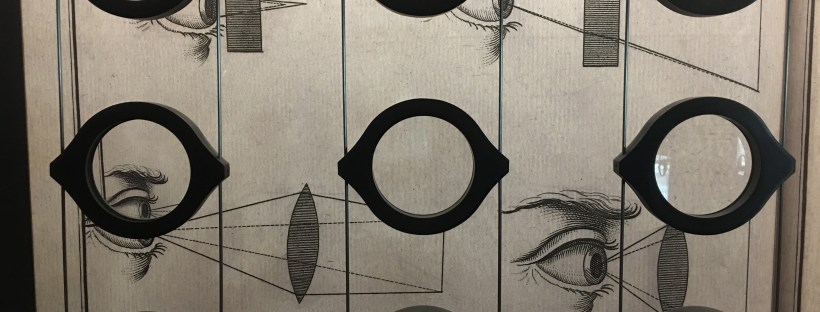
While I was impressed with several aspects of the museum, the coolest thing about it was its collection of old pre-cinema devices, the 18th and 19th century inventions that were popular right BEFORE cinema became a thing. So if you’re wondering what sort of moving images people watched before they went to the movies, then step on into the museum with me…

Continue reading

Madeira Mondays: A Visit to a Georgian Dining Room

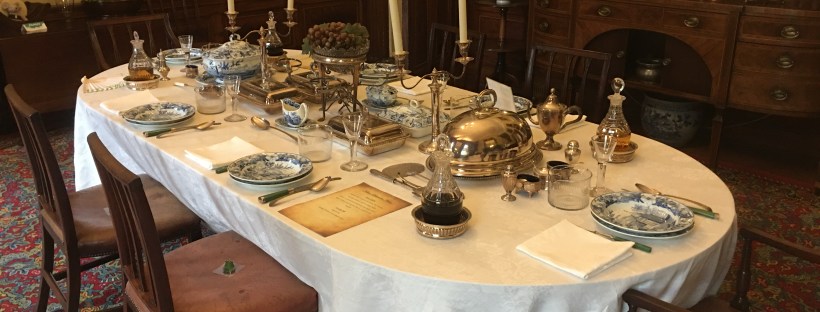
Longtime readers will know that I often spend my weekends volunteering as a costumed historical guide at The Georgian House here in Edinburgh. It’s a beautifully restored 18th century townhouse, where you can visit and see what life was like for the family who owned the house, and their servants who kept it running, in the late 18th/early 19th century.

I’ve written posts inspired by several spots in the home already: including the bedroom, the parlor and the drawing room. BUT I don’t think I’ve done a post yet about the dining room, which is often a favorite of visitors when they come to tour the house. I was in there last weekend telling people all about dining and food in Georgian Edinburgh so I thought this would be the perfect time to spotlight the dining room on the blog.

Continue reading

Madeira Mondays: Visiting Scotland’s oldest lighthouse

Hello everyone! Long time no see. It’s been a while since I posted on this blog and there are a couple of reasons for that. After I got home from my writing residency in March up at Moniack Mhor in the Scottish Highlands, I’ve been full speed ahead with various things including: applying for and becoming a permanent UK resident (which involves studying for and passing a TEST about UK history, law and trivia, harder than it sounds…), teaching at the Scottish Universities International Summer School (SUISS) at Edinburgh Uni and also editing my NEW BOOK, a novella, which will be published with Speculative Books this autumn (more on that in a future post!). I also finished a draft of my first full-length poetry collection, about cosmic wormholes, and the first very rough draft of a science fiction novel. Whew! All of this is to say: I have missed you and I definitely wanted to work on this blog, but other things had to take priority.

I want to work on this blog more in general but – to be very frank with you – one of the reasons that I don’t is simply because it’s a hobby and I don’t earn anything from it. I write this blog for love and because I enjoy talking about these topics (history! books!!). But, sadly, I have considered stopping it altogether, as things have gotten busier since lockdown ended and other projects are always vying for my attention. Still, I had people asking me where the blog has gone and expressed that they loved reading it. SO I have set up a Ko-fi account here, which, if you’re not familiar with it, is a place where readers can ‘tip’ writers for their work by ‘buying them a coffee’ 🙂 It’s a really easy, casual system. So if you’ve enjoyed this blog through the years, if it’s meant something to you, if you’ve learned something from it and want to keep it alive, please do consider ‘buying me a coffee’ on Ko-fi to show your support for it. It would mean a lot! You can also leave a message with your donation and please let me know what you enjoy about the blog (a favorite post maybe or what you’d like to see more of!). Thanks very much, friends!

And now back to our regular content! 🙂 Today’s post is about my visit to the Isle of May, a gorgeous and desolate island in the North Sea, off the Scottish coast. You can get a boat there from the quaint fishing village of Anstruther that takes about an hour. Although be forewarned that it’s a journey on open seas so the waves can be choppy! If you suffer from motion sickness, this may not be the adventure for you. Both me and my partner felt a little queasy when we arrived, although, on the plus side, it was seal season when we went in August and there were dozens, maybe a hundred, slick seals lounging around and playing on the rocks which we saw from the boat. (I didn’t get any pictures, they were too far away, but the wildlife is one of the best things about the island).

Our boat docked in a little harbour

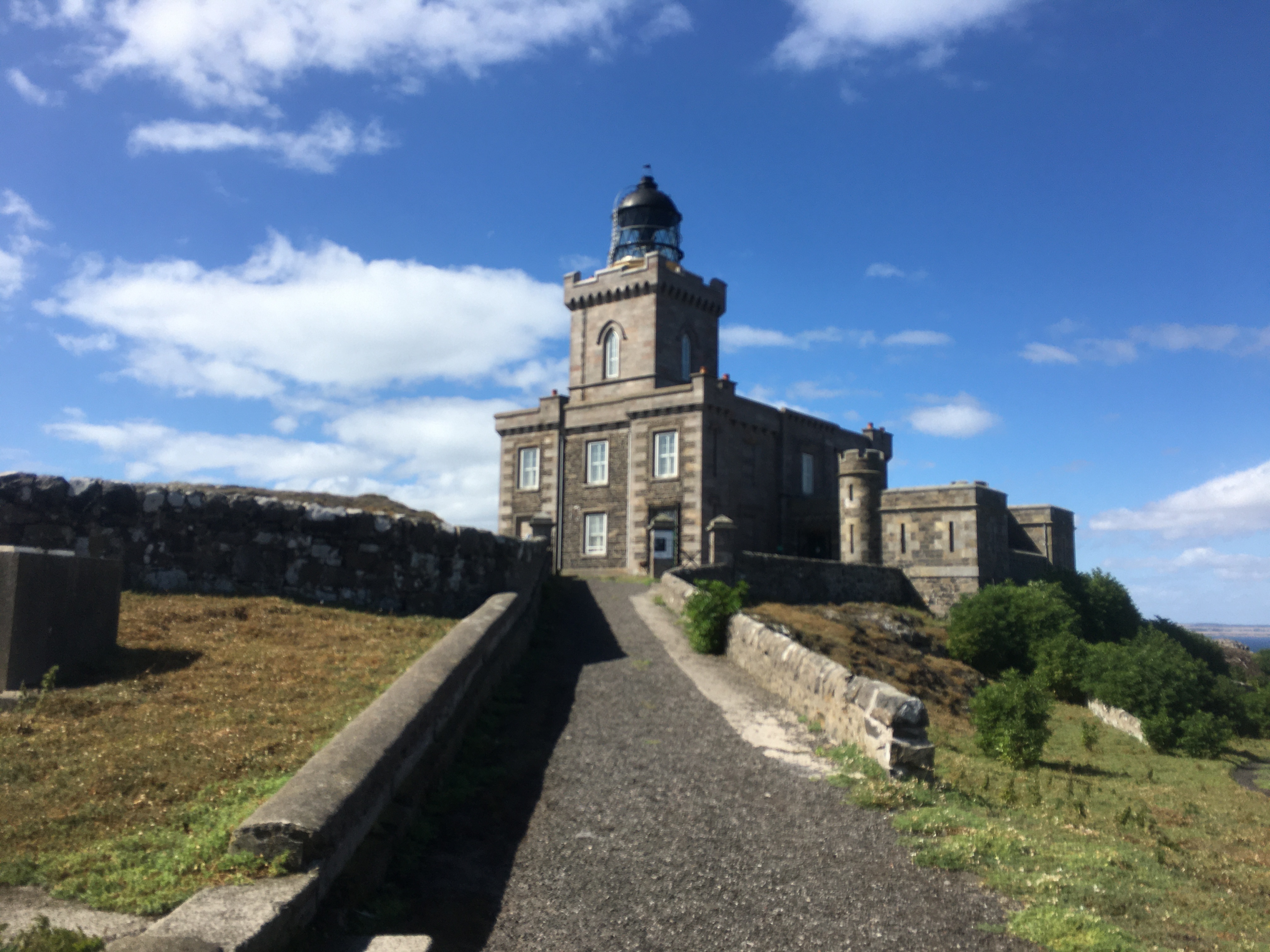
If you take the boat out (which is probably the only way to access the island) you are given a few hours to explore before needing to head back. Something about the tides means that the visiting windows are sadly pretty limited. We high-tailed it to the ruins of the old medieval monastery first, before checking out the Stevenson Lighthouse (did you know Robert Louis Sevenson’s family built lighthouses? Famously so! They were the ‘Lighthouse Stevensons’. Visits with his father to remote lighthouses are thought to have inspired his books Kidnapped and Treasure Island).

The Stevenson Lighthouse, built in 1816

From this lighthouse, you could see an even older one, The Beacon, Scotland’s first lighthouse, built in 1636. You can’t go up The Beacon, but it’s visible from many places on the island.

The Beacon, Scotland’s first lighthouse

Honestly the best thing to do on the island though was just to walk around and take in the awesome and desolate landscape. The wind is fierce out there and if you’re lucky you’ll be there during puffin season and can see all the puffins who make the island their home. Aside from them, it’s a home only for some scientific researchers, so when you visit it’s quite bare! There were no puffins when we went, but we saw their homes, burrows, in the ground on the sides of the path and you’re asked not to step on them, because the puffins return to the same home each year when they come back. So wouldn’t be nice for them to arrive back and have their house destroyed!

In addition to puffins, the island has played host to many different characters. It was the hiding place of a group of 300 Jacobites for eight days in 1715 (for more on the Jacobites, see my visit to Culloden). It was also a hotbed of smuggling in the 18th century, with all the wee coves and caves making it a good place to hide out. It was also home to a small fishing village in the 17th and early 18th century. And an 18th century innkeeper’s daughter even claims to have been attacked in a cave by kelpies, the legendary Scottish water horses.

We saw mostly seagulls on our trip, but I would definitely come back again (despite the queasy boat ride) to see more of the unique and dazzling landscape and explore more of the rugged, mysterious island.

Me rocking my rain poncho – it wasn’t rainy but super windy
The view out over the North Sea

‘Madeira Mondays’ is a series of blog posts about 18th century history and historical fiction. Subscribe to the blog for a new post every first Monday of the month.

Join my quarterly newsletter (for my writing news!) / Twitter: @TheForthBelle

Buy Me a Coffee at ko-fi.com

Madeira Mondays: Scotland’s best preserved 18th century town

I was hesitant to write this month’s ‘Madeira Mondays’ because the town I wanted to write about, Cromarty, is something of a ‘secret’. By this I mean: it’s an off-the-beaten path stop for international tourists. I (selfishly) didn’t want to share it! However, it’s an absolute GEM of a town: which manages to encapsulate Scotland’s past in numerous ways – ancient myths, Georgian prosperity, industrial decline, and a heck of a lot in between. Not to mention the beautiful natural environment, including breathtaking walks and dramatic sea views everywhere you turn.

The town was recommended to me by one of the staff, Isobel, at Moniack Mhor, Scotland’s National Writing Centre, where I had been staying for their International Writers Residency during the month of March. My partner and a friend were coming to pick me up at the end of the residency and we wanted to go somewhere in the Highlands. I asked for a recommendation for a pretty small town, that had some history and opportunities for walking nearby. Cromarty fit the bill.

So, even though I’m reluctant to ‘share’ this special place with the wider world, this ‘Madeira Mondays’ blog series is all about celebrating history and especially 18th century history, so it would be kind of unfair of me not to! 🙂

Continue reading