Friday Finds: Ghost: 100 Stories to Read with the Lights On, edited by Louise Welsh

‘in a story, which is a kind of dreaming, the dead sometimes smile and sit up and return to the world.’ – Tim O’Brien, in ‘The Lives of the Dead’

I love a good ghost story. While I’m a bit of a scaredy-cat when it comes to scary movies, I feel like ghost stories are perfect reading material for this time of year (or, really, every time of year). And I think books are the perfect place to encounter ghosts. As the quote above says, stories are a ‘kind of dreaming’. They are like the ghosts of either the writer, or the characters, or some combination of the two coming to life in our minds, even if that writer is long gone. We resurrect them.

Continue reading

Friday Finds: American Wife by Curtis Sittenfeld (book review)

Welcome to the first Friday Finds: where I share mostly book recommendations (or recommendations of other cool things I’ve come across). For this week I wanted to chat about American Wife by Curtis Sittenfeld. This book came out in 2008 and it’s a novel inspired by the life of the former first lady Laura Bush. A friend of mine handed me the book when I visited York recently and while I was initially a bit unsure – I have no particular interest in Laura Bush and I don’t read a lot of political biographies or autobiographies – once I started it, I was totally swept away. It reminded me more of a sweeping 19th century novel – something like Anna Karenina maybe – that encompasses a coming-of-age story, explorations and reflections on love and marriage, a good bit of melodrama and tragedy, a smattering of politics, and a whole lot else in between.

Continue reading

Madeira Mondays: Chasing Venus: The Race to Measure the Heavens (book review)

A few weeks ago, a billionaire went to space in a rocket. I’m really not impressed. What does impress me is the work that scientists and actual astronauts have been doing for years to map the heavens and better understand our place in this vast, incomprehensible universe. On that note, I wanted to recommend a book which I read last summer that combines two interests of mine: history and outer space. It’s a non-fiction book about the first ever global scientific collaboration conducted on Earth, which actually happened in the 18th century!

The book is Chasing Venus: The Race to Measure the Heavens by Andrea Wulf. It has adventure on the high seas, it has danger, it has rivalries, and best of all it has international cooperation (something that we could use a lot more of these days).

Continue reading

Madeira Mondays: A Witch in Time by Constance Sayers (Book Review)

This book was such a pleasant surprise! I should say immediately that when I received it as part of my subscription to ‘How Novel’, which sends you a mystery book each month, I was a bit turned off by the ridiculous and goofy title: A Witch in Time.

The UK paperback version of it that I received had a lovely cover with intricate gold designs but the title…my initial reaction was to roll my eyes. I personally struggle with titles so – I get it. Titles are hard. And I know that titles should, ideally, from a marketing perspective, reveal something about the content of the book to those who haven’t read it. But to title a book about a time traveling witch…’A Witch in Time’? It’s actually a little bit insulting to this rather well written, well researched and overall interesting novel – to give it such a goofy title based on a bad pun! I am convinced the author did not pick this silly title!

That being said – I really enjoyed A Witch in Time (arg! I can barely write it!), which tells the story of a woman reincarnated in four different time periods (ranging from the 1890s through to the mid 2000s) and cursed to relive a doomed love affair in each. A lot of the book is about art (we meet several artists, painters, photographers, writers) and also about breaking the (sometime self-destructive) patterns of behavior that we find ourselves in – more on that in a second.

Continue reading

Madeira Mondays: Ben Dorain: a conversation with a mountain (Book Review)

‘Imagine/you’ve spent hours walking the mountain/deeper and deeper in/until you’ve come to know its paths/its rocks and burns, its deer trails/as well as you know the surface of the leaf/held all day between finger and thumb’ – from Ben Dorain, ‘Part Five: Colour’

This is an immensely special book. It’s the sort of book where, as I was reading it, I kept putting little sticky notes next to phrases or words I liked – until the pages were too cluttered up with sticky notes and I had to force myself to stop.

Frequently I post on this blog about ‘historical fiction’ i.e. fictional works set in a previous era (usually the 18th century!). This book is not historical fiction per se but it certainly concerns history and approaches history in some pretty unique, challenging and ultimately really fascinating ways. It’s a book of poetry which is at once a loose translation of an 18th century Gaelic poem by Duncan Ban MacIntyre AND an entirely new poem by author Garry MacKenzie. Both poems explore a highland mountain called Ben Dorain, and specifically a herd of deer who live there. Both the old and the new poems are positioned next to each other – side by side – on each page. They intermingle, as past and present often do, into one new whole where, as MacKenzie writes in his introduction, ‘various voices and traditions speak alongside each other.’

Continue reading

Madeira Mondays: ‘For I will consider my cat, Jeoffry’

‘(Christopher Smart’s) poem about his cat is to all other poems about cats what The Illiad is to all other poems on war.’ – TS Eliot

These days, lots of people post pictures of their pets online. We can see these pictures as little tributes, little celebrations of these animals – their cuteness, their ridiculous quirks, their personalities. Back in 18th century London, Christopher Smart, a ‘mad’ poet living in an insane asylum, wrote a tribute to his feline companion, an orange cat called Jeoffry, in the form a poem. The lines that he wrote about Jeoffry became some of the most famous words ever written about a cat in all of English literature, and over the ages, Jeoffry has become a bit of a literary celebrity.

Oliver Soden’s delightful little gem of a book Jeoffry, The Poet’s Cat: A Biography (2020) imagines the life of Jeoffry the cat himself and his misadventures in Georgian London.

Continue reading

Madeira Mondays: These Shallow Graves by Jennifer Donnelly (Book Review)

”I merely wish to smoke. Sparky can forgive that. You, on the other hand, wish to know things. And no one can forgive a girl for that.” – These Shallow Graves

One of my favorite films growing up was Martin Scorsese’s Gangs of New York. Not typical fare for a teenage girl, sure, but I liked seeing old New York – the glitzy and the grimy. I don’t have any particular desire to live in New York City but it really is a fascinating place, isn’t it? A little Colonial Dutch outpost that slowly became a commercial mecca and now a world center of finance, culture, food, fashion, you name it. And seeing old New York (specifically 1890’s New York) was one of the coolest things about reading These Shallow Graves by Jennifer Donnelly. The book is a Young Adult mystery novel, published in 2015, which follows an upper class society girl who dreams of becoming a reporter and gets mixed up in the city’s underworld when she starts investigating her father’s mysterious death. 

Continue reading

Madeira Mondays: The Devil and the Dark Water by Stuart Turton (Book Review)

What if Sherlock Holmes boarded a 17th century ship? What if, on this ship, there was a series of dark and unexplained happenings: animals slaughtered, strange marks appearing, and, eventually, people murdered. How would Holmes go about solving these crimes and unmasking, as it were, the ‘devil’ lurking in the ‘dark water’?

While Stuart Turton’s novel, The Devil and the Dark Water, of course doesn’t actually feature Sherlock Holmes, it’s obvious that’s what he’s referencing with his central character of Samuel Pipps (who calls himself a ‘problematary’ because, as Turton clearly knows, the whole concept of ‘detective’ wasn’t around in the 17th century, when this book is set). Pipps, and the other characters in the novel, use deductive reasoning to solve the mysterious murders happening on their ship, as it travels from Batavia (present day Jakarta), in the Dutch East Indies, back to Amsterdam. They follow clues, they speak and think very much like Holmes himself. Continue reading

Madeira Mondays: Fever, 1793 (Book Review)

Ever since Covid-19 broke out across the world, there’s been a lot of talk about the Spanish Flu pandemic of 1918. I’ve also heard historians, especially medievalists, called upon to talk about the bubonic plague of the 1300’s, and I’ve seen Daniel Defoe’s 1722 book, A Journal of the Plague Year, added to many people’s reading lists! All of this makes sense. People are curious about pandemics of the past and how people coped (spiritually, physically, psychologically) with rampant infectious diseases.

That curiosity is what drove me to read Fever, 1793 by Laurie Halse Anderson. This is a YA (Young Adult) novel published originally twenty years ago, but it definitely has a lot of relevance today. It’s about an epidemic that you may not have heard of: the outbreak of yellow fever in Philadelphia in 1793. Continue reading

Madeira Mondays: Great Expectations (Book Review)

‘I never had one hour’s happiness in her society, and yet my mind all-round the four-and-twenty hours was harping on the happiness of having her with me unto death.’ – Charles Dickens, Great Expectations

I was meant to read Great Expectations at university. I know that because I have a distinctive memory of one of my professors, who was also my undergraduate dissertation supervisor, Phillip Mallet, discussing and dissecting the ending of this book in front of our Victorian novel class. I nodded along like I knew what he was talking about (It was not the first time I had sat through a lecture on a book I hadn’t read!). And while Phillip Mallet was an excellent lecturer, I’m glad I remember very little of what he said because this book was so full of twists and turns, it would have been a shame to learn about them all secondhand.

Which is why I will try – for today’s Madeira Mondays – to discuss this book without spoiling it. What I can spoil is that: I thought it was amazing. I enjoyed it even more than A Tale of Two Cities, which I reviewed last summer. What makes it so great, you ask? Well I shall endeavor to tell you (spoiler free!!), so you can decide if it sounds like a book you’d enjoy too!

What’s the book about?

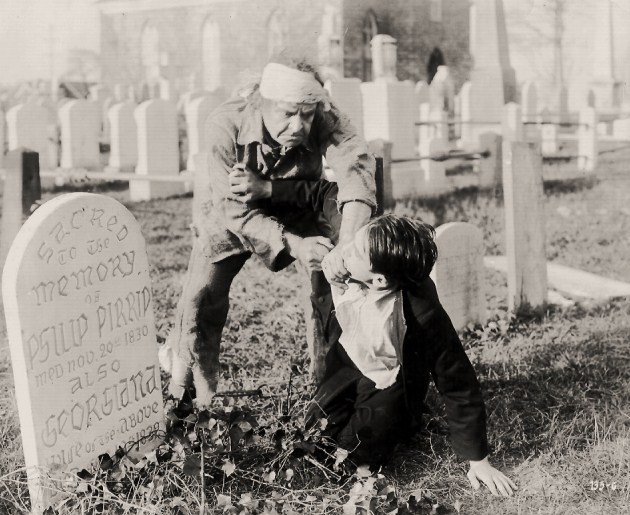
Great Expectations (1860) is a coming-of-age story. It’s probably one of the most famous coming-of-age stories in the English language, I’d say? It tells the story of a young orphan called Phillip, nickname ‘Pip’, who, in the famous first scene, encounters a terrifying escaped convict in a graveyard, demanding Pip’s help. ‘Keep still, you little devil,’ the convict cries, ‘or I’ll cut your throat!’ The convict is described as vividly as you would expect from Dickens, who is a MASTER at character descriptions, and zooming in on little details of people’s clothing or physicality to give you an amazing picture of who they are. The convict, who we later learn is called Magwitch, is described as:

A fearful man, all in course grey (…) A man who had been soaked in water, and smothered in mud, and lamed by stones, and cut by flints, and stung by nettles, and torn by briars; who limped, and shivered, and glared and growled; and whose teeth chattered in his head as he seized me by the chin.

Can’t you see the convict? I can. And, again without giving anything away, this book is populated throughout with many similarly vivid characters – from the terrifying and tragic Miss Havisham, jilted at the altar and who still, many years later, wears her wedding dress and haunts her own dilapidated manor house, to her beautiful, serene, cold-hearted protegee Estella.

Pip meets Magwitch in the graveyard. A publicity still from a 1917 adaptation of the book from Paramount Pictures, accessed via Wikimedia Commons

Pip must navigate complicated and, at times, heart breaking interactions with all these people as he grows up and tries to ‘better’ himself and improve his social class in Victorian England. Along the way, he makes mistakes (so many), which leads me on to why I think this is probably the best Dickens book I’ve read so far. Pip is probably the most believably human character I’ve encountered in a Dickens novel (keep in mind, I’ve only read A Christmas Carol, A Tale of Two Cities and this one). I love Dickens, as you know, but usually he’s one for larger than life characters, who sort of STAND for something (greed, corruption, etc.) rather than having characters who just feel like people. Great Expectations certainly has a lot of those larger than life figures, but because it’s a first-person narrative (this is Pip telling his story), and Pip just feels so human and fallible, I thought it was the most complex and involving of his books I’ve read.

What does Pip do that is so human and realistic? Well, he makes a lot of bad choices. Namely, and this doesn’t give too much away, he immediately falls in love with Estella who is, to put it bluntly, an asshole. We (the readers) know it. Pip knows it too. Dickens knows it. Everyone knows it. She’s so mean to him, for years, and yet…he’s infatuated with her, dreams of marrying her etc. I totally believed this. It’s such a poor choice to pursue her, and yet. People do this kind of thing in real life all the time. They become enamored with people who aren’t nice to them, they idealize their beloved and they let people become symbols, in a sense, making them more than what they are. For example, Pip loves Estella because in many ways she represents the refined, upper class life he so craves. If he can have her, he can have that, etc.

Again, I don’t want to reveal too much, but Pip makes so many selfish and short-sighted decisions, while, overall, being a fairly decent person. He’s never so awful or so cruel that you strongly dislike him, he’s mostly just a bit careless and self-centered (as people often are!). By the end, I totally believed in his humanity and I very much wanted him to be happy. But what is happiness? Is he going to have to learn to redefine what it means to him over the course of the book…who knows?? (hehe)

Also, as a bit of an aside, Dickens gets a lot of flak for his portrayal of women. I can understand that. In the three books of his I’ve read, none of the women reach near the complexity of a character like Pip, or A Tale of Two Cities‘ wonderfully compelling Sydney Carton. His women are interesting – no-one can say that Miss Havisham isn’t interesting!! – but they’re extremes. They’re extremely eccentric, or extremely angelic, or extremely violent, etc. I’m not sure we can entirely blame Dickens for this. Did his society encourage him to consider the internal complexities of the women around him? Probably not. Did he speak openly and candidly with women (his wife, friends, sisters) about their lives? Probably not. I’m just saying that Dickens in many ways was an author who wrote what he knew, and I don’t think that he knew, or could possibly even imagine, what sort of fears, hopes, desires, dreams would be in the heart of a little girl like Estella, versus a little boy like Pip. It’s a limitation of his writing, but not one that ruins it for me, by any means. I loved this book.

‘I entreated her to rise’, an illustration of a scene between Pip and Miss Havisham towards the end of the book, from an 1877 edition of Great Expectations. Image via Wikimedia Commons

One final other ‘flaw’, in my opinion, is that the middle of the book drags a bit, but the first section and the final section were incredibly paced and made up for a bit of a lull in the middle.

I’d recommend Great Expectations if you’re into character-led stories, whereas I’d recommend A Tale of Two Cities if you’re into more action-led stories. That book was a lot about justice, redemption, protests, mercy, whereas this one is a lot about inheritance, class, and how, as we grow up, our values and our priorities change. Even though Cities was set in the 18th century (my time period!), I think I preferred this one. I’m a sucker for a good first-person story and this is probably one of the best I’ve ever read.

‘Madeira Mondays’ is a series of blog posts exploring 18th century history and historical fiction. Follow the blog for a new post every Monday and thanks for reading!