
What you think about a historical figure often depends on where you were educated. Take Napoleon. Growing up in the US, Napoleon was described in my schools (if he was mentioned at all) as a kind of over-ambitious conquerer. People even say ‘Napoleon complex’ for a small man who tries to overcompensate for his size. But I recently learned from my partner, who is Italian, that in Italy he’s a more positive (if still complex) figure. He conquered Italy, yes, but Italy was sort of in shambles anyway at the time and he paved the way for future revolution and the democratic ideals that would unify Italy a century later. In France I understand him to be a divisive, complex figure too, especially considering his decision to reinstate slavery after it had been abolished in France.
I personally don’t claim to know a lot about Napoleon. He’s not a person I’ve ever studied, and, beyond Waterloo, I couldn’t name one of his famous battles. My main associations with Waterloo are the ABBA song and also that it features in Vanity Fair (brilliant book btw). So I went into Ridley Scott’s Napoleon with an open heart and an open mind. I wasn’t looking for historical inaccuracies (though I’ve heard there are many). I was looking for entertainment.
I did not get it.
I’m sorry to say it, but this movie was dull and it was long. So long. 2 and a half hours and you feel them. And, bizarrely, Scott wants to release an even longer cut of it, focusing more on Josephine. While that might fill in some of the weird gaps in this story (years are passed over so swiftly in this movie!), I can guarantee you I won’t be sitting through it.
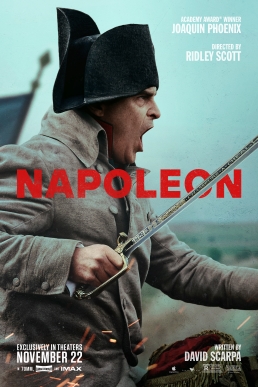
It’s rare for me to dislike a movie this much, but I’ve got a few major beefs with it as a viewer. Firstly, Napoleon isn’t charismatic at all. I don’t know if the historical man was meant to be charming, but I have a hard time believing that someone as strange and and sulky and charmless as Joaquin Phoenix’s character would have ever conquered most of Europe. Who would have listened to him?
Secondly, while the battles were exciting to watch, they are long and I had no sense of their significance. There was only one – the battle of Austerlitz – where I felt I got a sense of what was going on and why it mattered. In that battle, Napoleon showed his military brilliance by outsmarting the enemy using the winter setting. Excellent. However, in other battles the soldiers do things (such as when the British troops make a distinctive square formation) and I was like: is this famous? is it significant? do they often do this? I’ve never heard of it before but am I meant to know about this etc. etc.
Thirdly, the editing was quite jerky and strange. The main romantic relationship – which gets a lot of screen time – was really well depicted by the actors. I personally really like Vanessa Kirby from The Crown and think she’s got such soulful expressions that convey a lot in each scene. But years are skipped over in the blink of an eye and some of the most interesting characters are given little to no screen time (his second wife??) or disappear entirely (his brother??).
But worst of all: I left totally unsure how I was supposed to feel about Napoleon as a historical figure or as a person. I’m not saying it had to straightforwardly valorize or condemn him, but I didn’t have any idea of what Scott’s take on Napoleon was. That, for me, was the worst aspect: I wasn’t sure what the point of this was.
I also wasn’t sure at times if it was meant to be funny – there’s a moment where he’s out in the snow and looking grumpy. It’s clearly deep winter and then there’s a voiceover that says something like: ‘My dear Josephine, it’s very cold here.’ And I was like…why are we being told this? Is it a joke that he’s so dry in his letters?
I’ve really enjoyed many of Ridley Scott’s films (Gladiator, Alien etc.) but this one missed the mark for me!
Did you see Napoleon and, if so, what did you think? Am I being too harsh? Or did you have a similar experience?
Madeira Mondays are a series of blog posts about 18th century history and historical fiction. Thanks for reading!
Today’s Featured Image is Jacques-Louis David’s ‘Le Couronnement de l’Empereur et de l’Impératrice’, 1807/08, accessed via Wikimedia
PS I’m so sorry I’ve missed the last two months of Madeira Mondays. I’ve started a new job as Lecturer in Creative Writing at the University of Glasgow. It’s a full-time job and I don’t have much time to work on the blog, but I’ll keep returning to it when I can! Happy holidays to all!
 Carly Brown

That was my take on it. I wasn’t overly impressed!
LikeLiked by 1 person
Thanks for sharing! I really enjoyed reading your take and was intrigued (but not surprised) to learn more about the historical inaccuracies. I was also quite baffled by the death tolls listed at the end and it left me really puzzled (contributing further to my questions of: how exactly does Scott want us to feel about this guys? this suggests that he’s culpable for all these deaths??). Anyway I enjoyed the review a lot though I’m sorry you were similarly disappointed!
LikeLiked by 1 person
Thanks for saving 2 1/2 hours of my time!
P.S. I can’t remember if you reviewed this one or not, but I just finished The Awakening by Kate Chopin. I found the turn of the 20th century setting and female characters fascinating.
LikeLike
Thanks for your comment! Yeah sorry to be the bearer of bad news – perhaps you would like it if you saw it, but thus far I’ve sadly not talked to anyone who has enjoyed it!
You know, it’s funny you mention that book because I’ve had several people recommend it to me throughout the years so I think I really SHOULD read and review it for the blog (which I’ve never done!). Thanks for this suggestion! 🙂
LikeLike