Stay in and Read: Dracula

Most of us are looking ahead at a lot more time spent at home these next few weeks. So I thought I’d recommend a few excellent books that would make for perfect reading material during this time of ‘self-isolation.’ The wonderful thing about books is that, even if you are at home alone, they can provide a source of company and a means of imaginative escape. You can travel to distant lands (in the case of today’s read, 19th century Transylvania!), meet new people, and lose yourself in someone else’s adventure.

I’m going to try and recommend books which I think are especially ‘immersive’, that really plunge you into another place and time. These happen to be my favorite sorts of books anyway, so I’ve got lots of recommendations!

First up is a thrilling piece of gothic fiction! I read it for the first time last year and simply could not put it down and that is Bram Stoker’s Dracula.

IMG_0308

My epic copy of Dracula that I found a few years ago on sale at a gift shop. I thought I’d just use it as Halloween decor, but eventually read the book itself.

You might be familiar with one of the many film versions of this book, but trust me – the original book itself is well worth a read! It’s atmospheric and suspenseful and, in my opinion, no film version has ever captured the true spirit of the book. For me, Dracula is the original Scooby Doo. At its heart, it’s about a group of people who are trying to solve a mystery and defeat a dastardly villain intent on destroying their society. Lots of films try to make this into a romantic story, but to me it’s a tale of friendship and camaraderie.

If you don’t know the story of Dracula, I actually don’t want to give too much away (because the less you know, the more exciting the story is!). But it’s about a count with supernatural powers who tries to invade Victorian England. We follow various characters who try to figure out how to stop him, starting with the young lawyer Jonathan Harker who is imprisoned in Dracula’s castle in Transylvania at the start of the book. We also meet his fiancée Mina, her close friend Lucy, a goofy Dutch doctor who is an expert in the occult (I pictured Christoph Waltz for some reason), a Texan cowboy, an English Lord and a whole bunch of other people. All these people have to come together and try to stop Dracula’s plan, which is to turn more people into vampires (See, I bet you didn’t know that there was a COWBOY in Dracula? He plays a pretty big role too…). So in many ways it’s an appropriate story to read right now: one where smart people all come together to stop a dangerous contagion.

One of the things that makes Dracula such an engaging read is its epistolary style. It’s told in a series of letters and the occasional newspaper report which gives it almost a ‘true crime’ feel. The reader is piecing together the story, just as our characters do.

Another things that makes Dracula exciting to read, if I’m perfectly honest, is that it’s sexy. There is also a genuine terror in it of sex, particularly female sexual power. You have to read this book in the context of its own time (it was first published in 1897) and don’t except what we would call now ‘well-rounded’ female characters. Women are either pure and virtuous, like Mina, or literal demons who have fallen under Dracula’s power and want only to seduce and destroy men. But the female vampires definitely ARE super sexy. Take this passage when Harker encounters a vampire lady in Dracula’s castle:

The fair girl went on her knees and bent over me, fairly gloating. There was a deliberate voluptuousness which was both thrilling and repulsive, as she arched her neck she actually licked her lips like an animal, til I could see in the moonlight the moisture shining on her scarlet lips and on the red tongue as it lapped the white sharp teeth. Lower and lower went her head as the lips went below the range of my mouth and chin and seemed to fasten on my throat.

When people think of ‘classic’ novels, I think they imagine that these books are dry or tedious. That’s often not the case and it’s definitely not the case with Dracula (see passage above). Dracula is a strange window into Victorian fears (fears of female sexuality, fears of foreign invasion, fears of animal desires and impulses) and a damn good read. It’s one of my favorite books and, coincidentally, I’ve actually been to Transylvania (which is a part of modern day Romania!). I went there before I had read Dracula – one of my partner’s good friends lives there. But, now that I have read Dracula, I can picture even more vividly the haunting settings of Bram Stoker’s book: the mist-shrouded Carpathian mountains, the crumbling ancient fortresses, the steep ravines. But you don’t need to go to Romania to experience the world of Dracula. Just curl up with this fabulous book and let yourself fall under its spell.

IMG_0312

Stay tuned for more reading recommendations, and don’t forget to check out my series Madeira Mondays, every Monday, where I talk about early American history and historical fiction!

Do you have any reading recommendations for me? What books should I sink my teeth into (okay, there had to be one Dracula joke!) during this period?

I hope you’re well, and thanks very much for reading!
Madeira Mondays: Historical Short Stories

When we think of historical fiction, we tend to think about novels. It seems like a collective decision was made, somewhere down the line, that fiction set in the past should be EPIC in its scope. That historical tales were best suited to sprawling tomes with many sequels. Now, don’t get me wrong. I love a good historical novel (I’m writing one as we speak!). And I understand the appeal of getting wholly immersed in another time period, which one can do with a novel: learning about the minutia of life, meeting a big cast of characters, covering several years etc. BUT there is also something to be said for the short story as a medium for exploring history too.

Why are short stories such a brilliant form for historical fiction?

Well, for one thing, they reflect the way that the past often comes to us, which is in brief, fragmented, incomplete bursts. An old photograph discovered in an attic. A torn out page from a diary. Pieces of historical evidence often provide tiny windows to another world, but so much is left unknowable. Similarly, short stories are tiny windows into another world. A brief flash, a glimpse, but with much that you have to fill in and guess for yourself.

Also, maybe I am greedy, but sometimes I would rather read a collection with many different settings and characters, rather than commit to a whole book with just one time period and one setting. Enter Karen Russell. One of my absolute favorite writers. She writes both short stories and novels and many of her stories take place in the past – whether that is the old American West, 17th century Greece, or 19thcentury Japan. Lots of her stories are set in the present too. But all of her tales have fantastical or magical realism elements to them and they are all ridiculously well written. I actually feel wiser after reading her stories, like I have understood something new about human nature. Or, at least, have recognized something that I had not thought about before.

IMG_0205

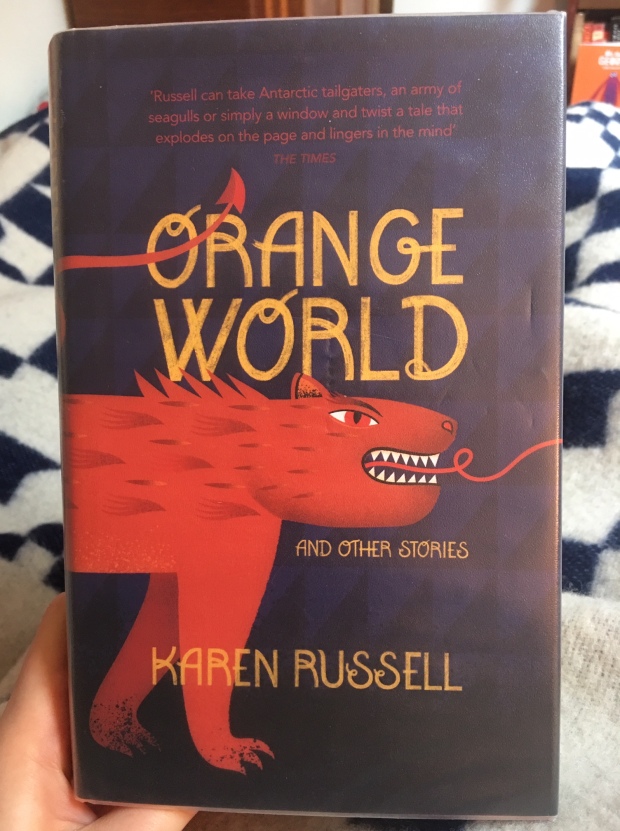
I was so excited to read her new collection last week – Orange World – and it exceeded my (very high!) expectations. So, for today’s ‘Madeira Mondays’, I wanted to point you towards some of my favorite, historical fiction stories by Karen Russell! Even though, regrettably, none of her short stories are set in 18th century America (Please write a story set in 18th century America, Karen! Please!!), lots of them explore other periods of American history and the American landscape. Here are four of her stories that I recommend reading ASAP.

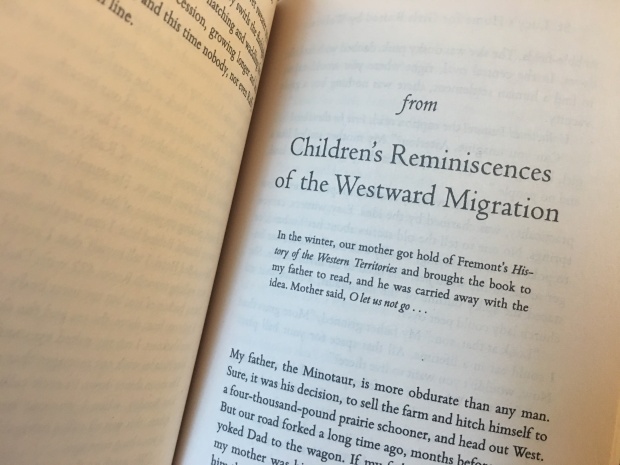
1 – ‘from Children’s Reminiscences of the Westward Migration‘, in St Lucy’s Home for Girls Raised by Wolves

Russell is an American writer originally from Florida, and many of the stories in her first collection, St Lucy’s Home for Girls Raised by Wolves, take place in a weird, heightened version of a Florida swamp. But she’s also clearly interested in the landscape of the American West and one of my favorite stories from that collection is titled: ‘from Children’s Reminiscences of the Westward Migration‘.  The title suggests a historical document, that the story we’re about to read is one from a larger collection of children looking back on their experience moving out west. But this expectation is playfully subverted in the very first line when we release that our boy narrator has a father who is a MINOTAUR. Yup. A Minotaur. Half-man, half-bull.

Thus begins a story that is really about myths: the myth of the American West (versus the harsh reality of life there), the myth of the Minotaur, the myth of this particular Minotaur character who, our narrator tells us, was once a famous rodeo star, AND about how parents seem like myths to their children, until we start to see their flaws.

You can hear Russell reading the beginning of the story here, to see if it might be your cup of tea!

IMG_0216

2 – ‘Proving Up’ from Vampires in the Lemon Grove

Russell’s second collection, Vampires in the Lemon Grove, is my personal favorite and there’s another story about the American West in it, although this one is much darker than ‘Westward Migration’. It is about the rapacious desire for land and ownership, and this dark greed manifests itself as a very dark force that threatens the characters, who are settlers on the American frontier. The ending is so sinister it took my breath away! Apparently it has also been turned into an opera.

3 – ‘The Barn at the End of Our Term’ from Vampires in the Lemon Grove

This is a goofy story which is dear to my heart, about US Presidents reincarnated as horses. Yes. Horses.

I actually wrote about it for part of my PhD thesis, which looked at different iterations of John Adams in fiction, because Adams the horse is a central character in the story. He tries to lead the other Presidents-turned-horses to rebel and break out of the barn. Sure, it’s a silly and fun concept, but it’s really about legacy and what kind of ‘afterlife’ these Presidents have in our imaginations. So it’s not so much ‘historical fiction’ as fiction ABOUT history. It’s also funny as hell and insightful.

4 – ‘Black Corfu’ from Orange World and other stories

Okay, so this story is definitely historical, but not set in America. The setting is the island of Corfu, 1620. I included it on this list because it is my favorite story from her latest collection and I’ve read it twice already. This story is about an ambitious, intellectual physician whose job it is to cut the hamstrings of corpses so that they do not rise from the dead and become zombies. He once aspired to be a great doctor, but his dark skin color and his class have prevented him from rising in his profession. When rumors start to spread that a dead woman has been seen roaming the island, the doctor is blamed and chaos ensues.

This story, like all of her stories, is about many things at once. Its themes are super relevant to us today, although they are explored in a historical context: class, race, science, superstition, ambition and the power of fear.

*

Have I convinced you to read her yet? I hope so! And I hope that you will enjoy these strange historical stories as much as I do.

Recommended Reading:

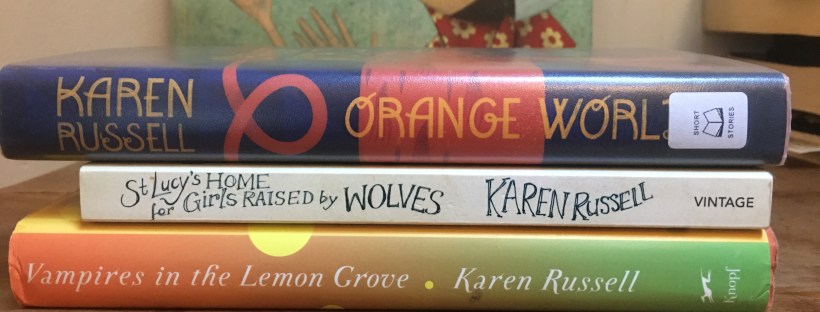
Orange World and Other Stories; Vampires in the Lemon Grove and St Lucy’s Home for Girls Raised by Wolves by Karen Russell (obviously!)

Voices Against the Wall: The Hilarious Terror of Karen Russell’s “Orange World and Other Stories” (in-depth review of Orange World and other stories) from the LA Times

‘Bog Girl’ by Karen Russell in The New Yorker (also featured in Orange World)

‘Madeira Mondays’ is a series of blog posts exploring Early American history and historical fiction. I’m not a historian, but an author and poet who is endlessly fascinated by this time period. I am also currently writing/researching a novel set during the American Revolution and recently finished a Doctorate of Fine Art looking at how creative writers access America’s eighteenth-century past. Follow the blog for a new post every Monday and thanks for reading!