Madeira Mondays: Thomas Jefferson, James Hemings and French Cooking

Thomas Jefferson is known for several things.

He is considered one of America’s ‘Founding Fathers’ and is probably most famous for writing The Declaration of Independence in 1776, a list of grievances that the American colonies sent to King George III which kicked off the American Revolution.  He’s also been in the press recently as Monticello, his home (which is now a museum and research center), grapples with how to represent the more uncomfortable truths about Jefferson’s life: namely that he kept hundreds of slaves (despite expressing a belief that slavery was morally repugnant) and fathered several children with an enslaved mistress, Sally Hemings.

So, he was a complicated man. And an endlessly interesting one.

I was actually fortunate enough to live at Monticello for a month in 2016 as a visiting research fellow while I was working on my PhD. During that time, I got to know Jefferson pretty well. And one of the most interesting aspects of his life that very few people know about is that he was a major foodie. This guy LOVED his wine and his culinary experimentation; he tried growing all kinds of things at his home in Virginia.  So it is no surprise that when he went to France in 1784, as an Ambassador of the new United States of America, he was keen that one of his slaves, James Hemings, go with him and be trained up as a French chef. So Jefferson and Hemings struck a bargain. If Hemings learned how to become a French chef in Paris and returned to Virginia to teach another slave the skills of French cookery, then Jefferson would free him. Hemings agreed.

This story, of James Hemings and Thomas Jefferson, their intertwined lives and culinary journeys, forms the basis of Thomas J. Craughwell‘s book Thomas Jefferson’s Creme Brûlée: How a Founding Father and His Slave James Hemings Introduced French Cuisine to America

book cover

It’s a fascinating story and Craughwell’s short, entertaining book covers their time in France as well as their return to the early Republic, when Jefferson became President and attempted to introduce French cuisine to the United States. Some of the foods that Jefferson and Hemings brought back included things we consider staples now, like macaroni and cheese and ice cream. Although they can’t be solely credited with introducing these to America, these foods certainly weren’t popular at the time, so Hemings and Jefferson were some of the first.

IMG_5103

Photo taken in the kitchens at Monticello in Virginia

One of the best things about Craughwell’s book is its informal, highly-readable style, from a non-fiction author who apparently wrote about many different historical subjects (from President Lincoln to Urban Legends). It’s an easy and accessible overview for those who aren’t too familiar with the time period. As someone who studies this period, I also learned some new things too, namely about the origins of modern French cooking (good and simple sauces, fresh ingredients sourced daily) and how its emphasis on simplicity was actually a reaction to the excesses of the Court of Versailles.
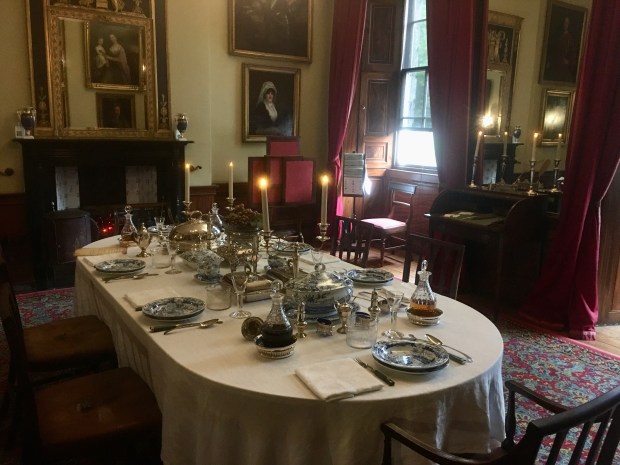
IMG_9361

From The Georgian House, recreated 18th century townhouse where I volunteer in Edinburgh

But as a whole the book felt a little too short and superficial. I wanted more description of the food James learned to prepare in Paris, and more about James in general as a person. Craughwell isn’t a historian and he does acknowledge that it’s difficult to find information about James, who did become a chef de cuisine, a master of French cooking, in Paris and was eventually freed by Jefferson. His story has a tragic end however: he committed suicide while drinking at the age of just 36.

Of course it’s significantly harder to learn about James’ character than about Jefferson. Jefferson was a U.S President and a wealthy white landowner who left an enormous amount of documents behind him: things he bought, letters he wrote, etc. James was born into slavery and although he ended up being free and self-employed as a cook in Baltimore, his life is, understandably, much harder to trace. I talk about this in my post about Juan San Malo from New Orleans, but it is a challenge trying to uncover the lives of those like James who don’t leave behind the paper trail of men like Jefferson.

Yet perhaps more information about how other French chefs were trained at the time in Paris (What their daily rituals were like? What sort of recipes they were learning?) would have given more insight into James’ situation. This would have been a good way to bulk out the James sections and wouldn’t have required gaining more information about him specifically. I just felt that there wasn’t enough about his life, or enough about the food he made, honestly. A lot of it focused on Jefferson’s life and his family, which is fine but there are other books which cover this and in much greater depth. With this book, I wanted to learn about French cooking and James Hemings.

That being said, Craughwell has clearly hit on a fascinating story and if you’re looking for a fun and fast-paced read about food and Early American history, then this wouldn’t be a bad one to choose. I’m a sucker for stories about food and am of the firm belief that someone should make a movie about James and his culinary adventures in Paris, his complicated relationship with Jefferson, his bringing French cuisine to America etc. It’s an interesting and unusual story. So get cracking, Hollywood!

Recommended Further Reading/Watching

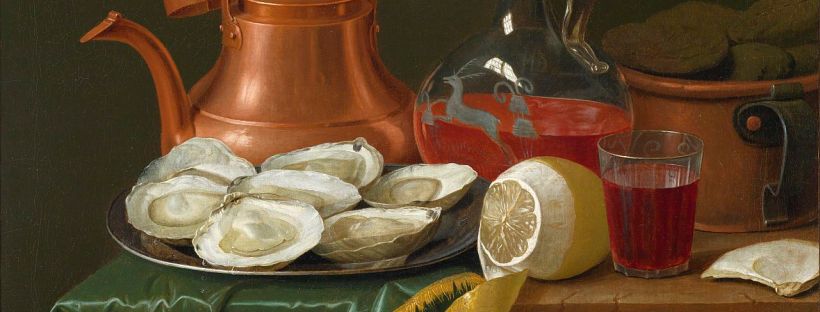
The Featured Image of today’s post is a still-life painting with oysters and wine from Flemish painter Peter Jacob Horemans, c. 1769, accessed via the Wikipedia Commons.

‘Madeira Mondays’ is a series of blog posts exploring Early American history and historical fiction. I’m not a historian, but an author and poet who is endlessly fascinated by this time period. I am also currently writing/researching a novel set during the American Revolution and recently finished a Doctorate of Fine Art looking at how creative writers access America’s eighteenth-century past. Follow the blog for a new post every Monday and thanks for reading!


Madeira Mondays: Runaway Slaves in 18th Century Louisiana

New Orleans is one of my favorite cities in the world to visit. Not only is it jam packed with delicious, flavorful food and music on every corner, there is also such a rich history there. Just have a stroll around the French Quarter and you’ll be able to see (and taste!) aspects of the many different cultures that shaped this unique city: Spanish, Afro-Caribbean, French, Anglo-American and Creole. It’s truly a one-of-a-kind place and I was lucky enough to go back there, for the first time in about ten years, for a family holiday this winter.

While we were there, I paid a visit to the Cabildo, a building that was once the colonial Spanish city hall but is now the home of the Louisiana State History Museum.

IMG_9992.JPG

The Louisiana State Museum: The Cabildo

We went in for the afternoon and while there were lots of interesting things to see – including a whole exhibition on the battle of New Orleans during the War of 1812 and its memory in pop culture – the exhibition that really stuck with me was was called: Le Kèr Creole (The Creole Heart): Runaway Slaves, Music, and Memory in Louisiana.

IMG_0018.JPG

The exhibition at The Cabildo

This is a multimedia exhibition featuring paintings, lithographs, and songs, alongside historical artifacts such as maps and period documents. It follows the story of a man called Juan San Malo, the leader of a runaway slave community in 1780s. But what really struck me was the format of the exhibition, which the museum describes as ‘a conversation between tradition and innovation.’ It’s part of an ongoing series apparently called In Dialogue, which features both traditional history documents (maps etc.) but also contemporary responses to those documents.

I liked this approach for several reasons. For one thing, men like Juan San Malo are usually left out of the traditional historical record. Even if we could find mention of him or runaway men like him, in perhaps letters, diaries, or newspaper ads from the time looking for runaway slaves, these documents would most likely have been authored by wealthy white landowning men, not by San Malo himself.

Also, San Malo was a Creole speaker. (Louisiana Creole was a francophone language created by enslaved Africans who lived on plantations in the region). By featuring many Creole songs in the exhibition, it tells San Malo’s story not only in his own language, but in a rare and endangered language of the area. The songs we hear are like an oral history of the region, an alternative history of New Orleans.

IMG_0012

One of the striking pieces of art featured at the exhibition: Morning Mist in Colony Maron, by Francis X. Pavy, 2017. I am not a visual artist, so this description means little to me, but this piece is described as ‘augmented photographic lithophane in carved acrylic’. All I know is that lithophanes are backlit and several pieces like this were part of the exhibition. I liked the use of shadow, given how little we know about Juan San Malo.

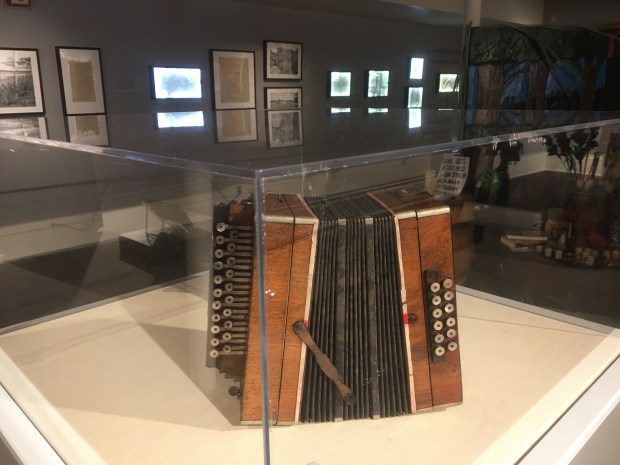
One of the historical artifacts that I especially liked seeing was the ‘diatonic accordion.’ I learned that apparently German immigrants brought accordions to Louisiana and, in the early 20th century, the instrument was adopted by Creole and Cajun musicians.

IMG_0003

German accordion from 1850

Another striking feature of the exhibition was the large altar in the center of it, where you could place offerings or write in a book about ‘a dream of freedom’. This was a fitting element, considering that San Malo, who created one of the largest runaway slave settlements in North America and was eventually hung by Spanish officials, seems to be something of a folk hero and even a saint, who people memorialized and turned to for strength. Words from a Creole song ‘Ourra St. Malo’ (Dirge for San Malo) can be read on the walls nearby.

IMG_0005

The altar in the center of the exhibition

One of the only things that I wished was different about the exhibition is that I wanted to know a bit more about the significance of the altar and how altars fit into Creole customs, because I know that Catholicism had a big influence in New Orleans (but maybe there was that information and I just missed it!). The only other thing that I wished was different was that I simply wanted more of the whole exhibition, as it was really just one room. But there is plenty to see in that room! I left feeling like I had learned something new about 18th century New Orleans and also with many ideas about how history can be communicated to the public, not just with maps and period documents, but with modern art and songs too. I thought about how this exhibition is not simply about one man’s life, but rather about the history of a language. A language which, in itself, IS history. Basically, it gave me a lot to think about! If you are in New Orleans, I would encourage a visit and do let me know what you think of it too.

‘Le Kèr Creole (The Creole Heart): Runaway Slaves, Music, and Memory in Louisiana’ runs until May 10, 2020 at The Cabildo.

Madeira Mondays is a series of blog posts exploring Early American history and historical fiction. I’m not a historian, but an author and poet who is endlessly fascinated by this time period. I am also currently writing/researching a novel set during the American Revolution and recently finished a Doctorate of Fine Art looking at how creative writers access America’s eighteenth-century past. Follow the blog for a new post every Monday and thanks for reading!


Madeira Mondays: The Patriot (Part I)

Rousing. Violent. Exciting.

These are the three adjectives that Netflix has chosen to describe Roland Emmerich’s film The Patriot (2000). And Netflix is right. Seeing Mel Gibson (fresh from his turn as William Wallace in Braveheart) hacking dozens of British soldiers to death with a tomahawk is definitely ‘violent’. Then seeing him riding with a tattered American flag on a horse at sunrise while men around him shout ‘Huzzah!’ is pretty ‘rousing’, I guess. And every time that Heath Ledger or Jason Issacs are on screen (two talented actors who get to really chew some scenery in this movie), it is ‘exciting’ for me, the viewer, to watch them act.

But while The Patriot might be rousing, violent and exciting, it is also a comically simplistic portrayal of a complicated time in America’s history. Let’s get one thing straight: this movie is an over-the-top melodrama of the highest order. Like any good melodrama, you can expect exaggerated, stereotypical characters and clear cut Goodies and Baddies. And wouldn’t history, and human nature, be much easier to understand if it was really like this? If there really were simply heroes and villains? Perhaps that really is the appeal of films like The Patriot. More than their violence, their star power, and their exciting set pieces (note the battle scene where the guy’s leg gets knocked off by the cannon ball!), these types of movies are comforting in their simplicity. They present a national mythology that is easy to grasp and that most people can get behind.

Mel-Gibson-in-The-Patriot-001

Mel Gibson as Benjamin Martin. The film came out several years before Gibson was blacklisted in Hollywood for his anti-Semitic comments made during a 2006 DUI arrest.

The Patriot presents a version of the Revolutionary War where the the British Army is seemingly populated entirely by incompetent aristocrats and psychologically disturbed sadists who go around committing atrocities without repercussions. I’ll be talking more about this in next week’s post, but to say that this film’s depiction of British army officers during the American Revolution is ‘inaccurate’ doesn’t go far enough. It is outrageous. American civilians were definitely abused by both armies, but nothing on the scale this film seems to suggest as far as I am aware and often that abuse was by the REBEL army towards Loyalists.

But before I get any further ripping into this film, I have a confession: I loved The Patriot as a kid. I watched it so many times that I could still recite it today. I watched it so often in part because I liked this time period and there are so few films and books depicting it, but also because there are some engaging and fun things about The Patriot. Not enough to redeem it, mind you! This is not a ‘good’ movie. It’s a fun, bombastic melodrama (check out my reviews of The John Adams Miniseries or The Witch for ideas of much better, more nuanced, movies set in early America).

But in fairness to The Patriot, I have decided to break this post up into two parts. Today I’m posting about things which I think work about this film. They are largely related to the talent of some of the actors. Next Monday, I’ll be talking about the things that do NOT work so well.

As a quick synopsis (skip this paragraph if you don’t want to be spoiled about the plot!): The Patriot is a story about a farmer with a troubled past, Benjamin Martin (Mel Gibson), who wants to remain neutral in the escalating conflict with Great Britain. But he’s pulled into the war when his headstrong son Gabriel (Health Ledger) joins the Continental Army and when an evil British officer, Colonel Tavington (Jason Issacs), murders his other son Thomas and burns his house down. The rest of the film follows Martin’s journey as he joins the rebel army and succeeds at every turn evading the British through guerilla warfare: stealing their supplies, planning sneak attacks, hiding in the woods and evading capture etc. Then Gabriel dies, also at the hands of Colonel Tavington, in a scene that is genuinely sad, especially given our loss of Ledger in real life. But all is well(ish) in the end because Martin enacts his revenge by killing Tavington and the Continental army wins the war (of course).

So it is a movie about a badass fighter man with a dark past who wants to get out of that life but is drawn into it when the baddies attack his family. Then he goes on a murderous rampage. This is basically John Wick…in the American Revolution.

As a side note, it made me laugh to learn that Harrison Ford declined the lead role in this because he said the film boiled down the Revolutionary War to a ‘one-man’s-revenge’ melodrama. Yup. That about sums it up.

That being said, there is some fun to be had here and some things that succeed in this movie.

Some things that work in The Patriot

1 – The score

As I was searching for things to praise, the music immediately came to mind. Then I looked up who scored it: John Williams! Even if you don’t know John Williams, you have probably heard his work. He scored ET, the Indianan Jones series, the first two Home Alone films, Star Wars, and the first three Harry Potter films. To name just a few.

The score in The Patriot is excellent and definitely ‘rousing’. It makes moving use of period instruments, like violins and flutes, and is delicate and hopeful. To be honest, the music is doing most of the emotional heavy lifting over a lackluster script and fairly cardboard characters (more on the characterization below). You can listen to the theme here.

2 – Everything looks pretty good

The material world of The Patriot seems to have been created with attention and care. For instance, there is a sampler on the wall in one of the opening scenes, in the girls’ bedroom, which is a nice touch. And as far as I can tell, most of the material culture stuff is well done. The elite women are never wearing head coverings outside during the day (like a mob cap etc.) for modesty, but that’s not a huge deal. And everyone looks too clean, but, by and large, I felt this stuff was fine. Apparently the film was even supervised by The Smithsonian. Of course I’m by no means an expert, but anything glaringly obvious I probably would have picked up on so well done to the costume and set designers.

patriot-1999-07-g

Gabriel (Heath Ledger) and Benjamin Martin (Gibson) at war.

3 – Warfare

It conveys the gruesome brutality of 18th century warfare – where men stood in lines and shot at each other, before stabbing one another with bayonets. Sometimes I would argue it relishes the fighting a bit too much, like when the cannon ball flies directly towards the camera, but director Roland Emmerich seems interested in these details. Perhaps more interested in these details than he is in the characters themselves. As for me, I’m not very interested in military history or in how 18th century battles are fought, beyond the basics, but zooming in (literally) on this works to convey the sacrifices that men on both sides of the conflict made to serve their country. You come away thinking that war is a gruesome and terrible thing, which is true.

4 – Tom Wilkinson

This talented actor is having a lot of fun as the pompous General Cornwallis, saying lines like ‘These rustics are so inept. Nearly takes the honor out of victory. Nearly.’ Fun Fact: he also gets to play a jolly, folksy Ben Franklin in the John Adams Miniseries. In some ways the mirror opposite of Cornwallis. What fun!

5 – Jason Issacs

As far as I’m concerned, Jason Issacs is the hero of this movie and not just because I have always found him a really charismatic and good-looking actor (although that helps). He is a hero because this actor is given nothing to do besides being a complete sadistic murderer, but it somehow works because he commits to it 100%.

Colonel_William_Tavington

Jason Issacs as Col. William Tavington

His character of Tavington is wholly one-dimensional and one level. Usually overtly evil characters like this are at least given one redeeming trait by the screenwriters – maybe they have a dog or a kid? Maybe they are seen enjoying a piece of music once? Basically, they are shown loving or appreciating something. Nope. Not Tavington. He basically just kills people or thinks about killing them. There is one brief moment of humanity when Tavington admits to Cornwallis that his father is a disgraced aristocrat and he has no inheritance. ‘I advance myself only through victory,’ Tavington says. It’s a thin and underdeveloped motivation for the levels of brutality that Tavington commits, but Issacs definitely nails this moment and we see a flicker of fragility in Tavington’s eyes. Still though, 98% of the time this character is written to be a cardboard cut-out of Evil. And yet. Issacs is a joy to watch. When you’re playing a role like this, you’ve just got to give it your all. And he does. No surprise that he later played Captain Hook in a remake of Peter Pan. He is basically already playing Captain Hook in The Patriot.

6 – Heath Ledger

Again. His character is non-existent. Like Issac’s Tavington, Ledger is given nothing to work with. His character of Gabriel Martin is just Earnest Young Hero Man. And yet. He’s not bland at all, but imbues Gabriel with a youthful exuberance, a quiet dignity, a curiosity for life, and a whole host of other traits that are not coming from the writing but the delivery. This was Ledger’s first big dramatic role and the career that he went on to have – Brokeback Mountain, The Dark Knight etc. – is not surprising at all, given his evident charm and likeable onscreen persona here. He also underplays some of the more dramatic moments, which is something this film desperately needs more of.

the-patriot

Heath Ledger as Gabriel Martin

7 – ‘They had green eyes’

In a movie full of over-the-top emotions and epic battle sequences, perhaps the only moment that I found truly sad and human was a tiny one, when the proud French officer Villeneuve (Tchéky Karyo) finally opens up to Benjamin Martin about the loss of his daughters who were killed by the British army (because that’s what the British army does in this movie, kills civilians left and right). Martin asks him, as they are marching in to battle, presumably about to die: ‘How old were your daughters?’ Villeneuve answers: ‘Violette was 12 and Pauline 10. They had green eyes.’ Maybe it’s the actor’s understated, almost numbed, delivery. Or maybe it’s just this small touch of specificity in a movie that is usually broad strokes, but I found this moment between the men genuinely touching. Martin has just lost his son, Gabriel, and it is a sweet moment of connection and shared loss between them. The screenwriter Robert Rodat could have used a lot more moments like this.

In general, some of the banter between the men also works well and there are a lot of quippy one liners where the militiamen are teasing one another which I felt was sweet and made the overall tone less self-important.

Jean_Villeneuve

Tcheky Karyo as Villeneuve

So there you have it. Some things that I genuinely appreciated about The Patriot!

In next week’s post, we are going in-depth looking at what isn’t working so well in this film, as well as some of the history that inspired it. In the meantime, let me know if you’ve seen The Patriot. It’s currently streaming on UK Netflix, so maybe it’s time for a re-watch even if you saw it twenty years ago when it came out. I’d love to hear your thoughts. See you next Monday for Part II!

PS If you’re looking for some historical fiction which isn’t at all like The Patriot, but rather a spooky, Victorian ghost story about sisters and séances, then check out my story The Astonishing Rivers Sisters, published this week in Halfway Down the Stairs magazine!

‘Madeira Mondays’ is a series of blog posts exploring Early American history and historical fiction. I’m not a historian, but an author and poet who is endlessly fascinated by this time period. I am also currently writing/researching a novel set during the American Revolution and recently finished a Doctorate of Fine Art looking at how creative writers access America’s eighteenth-century past. Follow the blog for a new post every Monday and thanks for reading!

Madeira Mondays: A Visit to the Museum of the American Revolution

I have wanted to visit the Museum of the American Revolution ever since I saw this CBS special about it. The museum opened very recently (2017) and last month, during my first ever visit to Philadelphia, I finally managed to stop in and see it for myself!

IMG_9426

It’s an enormous undertaking, trying to present the entire Revolutionary War (plus its lead up and its aftermath) to visitors. Some of those visitors (like myself) might know a fair amount about this period already, but some might be learning about it for the first time. From the look of it during my visit, it seems to be a popular place to take school groups, but it’s also right by Independence Hall and all the other major Revolutionary War sites in Philly so I imagine it attracts all sorts of tourists and visitors, both local and international. Overall I think the museum does a really great job of presenting the war from various different perspectives (political, racial, geographical, etc.) and conveying that this was a complex conflict and not matter of ‘good guys’ and ‘bad guys’. I actually heard one of the tour guides saying to a group of what looked like eight or nine-year-old school kids, ‘Now what did I say at the beginning of the tour? The Revolution was nuanced.’ Even using the word nuanced with kids of that age made me smile and made it clear just how committed the museum was to trying to tell a multifaceted a story of the Revolution.

IMG_9428

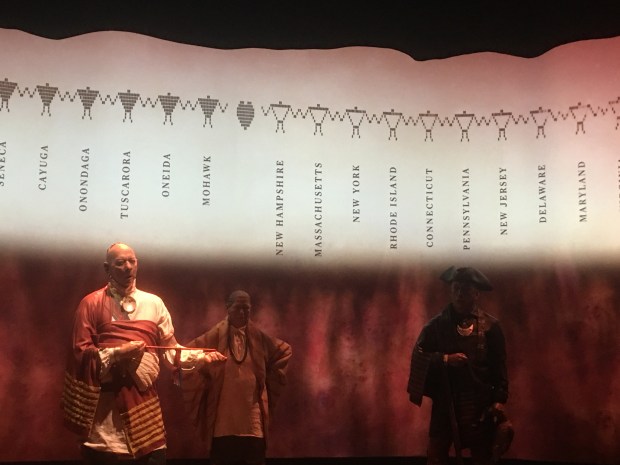
Of course the Revolutionary War was experienced differently by everyone who was alive during that time, but I think they did a relatively good job of exploring some underrepresented perspectives that I certainly wasn’t taught at school: the dilemmas of the people of the Iroquois nations deciding which side of the conflict to align themselves with, for instance. There is also some exploration of how many enslaved men ran away to join the British army in exchange for their freedom.

IMG_9459

Dramatic display inside the museum about the people of the Oneida nation deciding who to ally themselves with

Overall it is a very battle centered museum – the rooms are basically arranged to explore chronologically the different military campaigns. Since I’m more interested in social history (a fancy way of saying ‘how people lived’) and day to day life for women at home during this period, it didn’t appeal to me as much. But I also recognize that those are my particular interests. The Revolutionary war was a war, after all, so I imagine many people are primarily curious about the different battles and military engagements. It’s just not my cup of tea.

That being said, there was still lots for me to see and enjoy there. Here are a couple of things that stood out to me as particular favorites from my visit.

Phillis Wheatley book: They had a signed first edition of the first published book of poetry written by an African American woman, Phillis Wheatley. Wheatley is a fascinating historical figure in American history and literature (a blog post about her is forthcoming!). She was born in West Africa, but forced into slavery as a child and transported to North America. She learned to read and write from the Boston family she served and ended up becoming a famous, celebrated poet in her day.

IMG_9434

Phillis Wheatley’s book Poems on Various Subjects, Religious and Moral, 1773

George III statue fragments: The book that I’m working on is set in colonial New York, so it was really cool to see two original fragments of the statue of King George III that was pulled down in NYC on July 9, 1776. I also learned that based on the fragments, it’s been concluded that the statue featured George III in a Roman-style toga, which I had not known before and actually impacted a scene in my book! (Fun fact: Most of the lead from the statue was melted down into musket balls by the Continental army during the war).

Toy broom and toy platter: I liked seeing the itty-bitty toys excavated from British Revolutionary Campsites around New York City, reminders that the children of British soldiers were going around with the army in North America. I’ve never seen little pewter toys like this before and it was a charming sight.

‘Women’s Property and War’ display: Something that a lot of people don’t know is that after the Revolution, there were ‘confiscation’ laws passed and the new government started seizing the property of those who had remained loyal to the King. A lot of my PhD was looking at the experiences of women in South Carolina who suffered during and after the war because of their husbands’ politics and who lost their property due to these laws. This display featured furniture pieces similar to the furniture that was confiscated from the Drinker family (Philadelphia Quakers who tried to remain neutral during the war). I’ve read Elizabeth Drinker’s diary, and obviously have a lot of personal interest in this topic, so I was happy to see this particular display, although I would have been happy with even more about it.

Tea: I’m a big fan of incorporating multisensory displays at museums and there was a box where you could smell one of the varieties of tea that was thrown into the Boston Harbor during the tea party. (It was black and green tea thrown overboard).

IMG_9438

The mirrors at the end: When you’re leaving the exhibition there’s a big mirror and it says ‘Meet the future of the American Revolution’ at the top. It’s a very sweet visual reminder of our connection with the past and I really like the idea of school kids peering up at themselves and seeing themselves as part of this story. (Did I tear up a bit? Yes. Yes I did).

So overall it was absolutely worth a visit and if you’re in Philly you could quite easily tie it in with a visit to Independence Hall and the Liberty Bell. You’ll leave with a really clear sense of what led to the Revolutionary War, as well as the key moments and battles. There’s also a rotating exhibition on the ground floor, so do have a look at what is on there when you visit.

Thanks for reading and I hope that it’s helpful for anyone considering a visit! Museums like this always make me think of the tremendous challenge of communicating such a sprawling conflict to people and this museum did a good job. And let me know, if you’ve been already, what you thought of the Museum of the American Revolution – I’d be very curious.

See you next Monday!

‘Madeira Mondays’ is a series of blog posts exploring Early American history and historical fiction. I’m not a historian, but an author and poet who is endlessly fascinated by this time period. I am also currently writing/researching a novel set during the American Revolution and recently finished a Doctorate of Fine Art looking at how creative writers access America’s eighteenth-century past. Follow the blog for a new post every Monday and any questions or suggestions feel free to get in touch.